
Accompanying the rapid rise of artificial intelligence (AI) and remarkable growth of Taiwan’s electronics industry is an association of Taiwan with technological excellence, soaring corporate valuations, and booming semiconductor exports. However, workers in Taiwan’s traditional industries (mature, established manufacturing sectors established in the 1950s-1980s such as textiles, machinery, plastics, etc.) have largely been excluded from the benefits of this economic transformation. In many cases, these primarily blue-collar workers face increasing insecurity regarding both their employment and working conditions.
Even Japanese-invested companies, which have long been regarded in Taiwan as offering relatively stable employment and better labor standards, have recently become the center of major labor disputes with Taiwanese workers. These disputes are particularly notable, given that Taiwan and Japan have maintained close political, economic, and cultural ties even after the latter’s colonization of the former, with the notion of a “Taiwan-Japan friendship” becoming a dominant narrative recently. Nevertheless, a series of labor disputes involving Japanese companies operating in Taiwan has begun to create visible tensions between these corporations and Taiwanese workers.
Plant Closures and Mass Layoffs: The Cases of Shiseido and Bridgestone
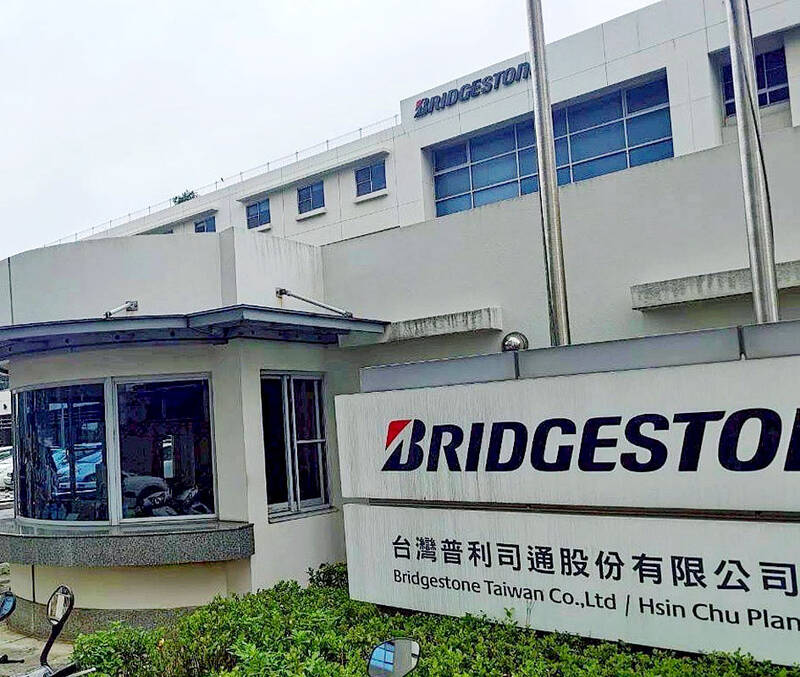
In May 2026, two major Japanese corporations, Shiseido and Bridgestone, announced the closure of their manufacturing operations in Taiwan. Shiseido, one of Japan’s most prominent cosmetics brands, employs approximately 2,600 workers in Taiwan, primarily in brand management, retail sales, logistics, and beauty consulting. The company currently operates only one manufacturing facility in Hsinchu, employing approximately 170 workers. In May, Shiseido announced that it would close the plant in 2027, resulting in the dismissal of production employees while retaining sales and marketing operations.
The impact of Bridgestone’s closure, however, is even more significant. Bridgestone, one of the world’s leading premium tire manufacturers, established its Hsinchu plant in 1982 to supply both the domestic and overseas markets. The facility currently employs approximately 550 workers and has operated continuously for 44 years. Over the decades, the plant has supported the development of a local industrial cluster, including suppliers in rubber materials, mold manufacturing, industrial gases, logistics, and equipment maintenance.
On Friday, May 8, 2026, Bridgestone notified government authorities and its employees that it intended to proceed with a plant closure and mass layoffs. On Monday, May 11, the company officially announced the immediate cessation of production at the Hsinchu plant and declared that its Taiwan operations would be transformed into a sales and service company, with products supplied by overseas factories. According to the Bridgestone’s labor union, the company arranged twelve buses on the day of the announcement and transported workers to four separate locations for what it described as “labor-management consultations.” The company subsequently claimed that a majority of workers had agreed to its proposed severance package. Bridgestone’s labor union strongly disputed this characterization. It argued that separating workers into different locations effectively prevented them from discussing the situation as a group, coordinating their positions, and exercising their collective bargaining rights. Union members were denied meaningful opportunities to exchange information and formulate a common response.
Under Taiwan’s Act for Worker Protection of Mass Redundancy, employers with more than 500 employees that intend to dismiss more than one-fifth of their workforce within a sixty-day period must notify local authorities and labor unions at least sixty days before implementing the layoffs. Employers must also submit a dismissal plan detailing the reasons for the layoffs, the number of affected workers, selection criteria, severance arrangements, and reemployment assistance measures. Within ten days of submitting the plan, labor and management are required to enter negotiations. If negotiations fail, government authorities may convene a mediation committee. The sixty-day notice requirement serves an important purpose: it provides workers with time to prepare, allows information to be disclosed transparently, and creates conditions for meaningful negotiations. Bridgestone’s actions, however, appear inconsistent with the legislation. Not only was production halted without meaningful prior notice, but the company’s approach also undermined workers’ ability to engage in effective collective action.
Crucially, the consequences of Shisedo’s and Bridgestone’s factory closures extend beyond their workers. Industrial clusters and local communities that have developed around the factories over several decades are now facing substantial economic and social disruptions.
Unilateral Reduction of Working Conditions: The AGC Case
In addition to plant closures and mass layoffs, another Japanese company operating in Taiwan has become embroiled in labor disputes involving the unilateral reduction of working conditions. AGC Inc., one of the world’s leading materials manufacturers, operates display glass production facilities in both Yunlin County and Tainan City. The company produces a wide range of products, including architectural glass, automotive glass, display glass, electronic materials, and chemical products. In recent years, AGC’s electronics division has become the group’s fastest-growing and most profitable business segment. AGC’s operations in Taiwan are part of this electronics division. As global display markets face oversupply, AGC has sought new growth opportunities, including a transition from consumer electronics applications to higher-value automotive display products. At the same time, the rapid expansion of generative AI, big data, and 5G technologies has increased demand for advanced semiconductor packaging. Glass substrates, with their superior thermal stability and low signal loss characteristics, are increasingly regarded as a key enabling technology for future AI-related applications. Given Taiwan’s dominant position in advanced semiconductor manufacturing, AGC’s operations in Taiwan occupy an important position within the company’s future growth strategy.
Despite these growth opportunities, labor disputes have recently emerged at AGC Display Glass Taiwan’s Yunlin facility, where workers have reported a series of unilateral reductions in long-established employment conditions. For example, employees who reached certain years of service traditionally received commemorative gold medals as a recognition of long-term service. Following increases in gold prices, the company unilaterally decided to replace the medals with cash payments significantly below their market value. In addition, during annual wage and compensation negotiations, the company rejected the company union’s proposal to maintain the long-standing compensation framework providing sixteen months of annual salary plus performance bonuses. As a result, workers face the prospect of a reduction in annual earnings. Although labor-management mediation procedures have been conducted, the disputes remain unresolved. The company has continued to implement these changes, while the union has organized numerous membership meetings and is preparing further collective actions. While AGC is expanding its role within emerging technology supply chains, workers at its Yunlin facility are experiencing a deterioration in working conditions and income security. This contrast has become a central concern in the ongoing labor dispute.
Labor Organizations Petition Japanese Authorities
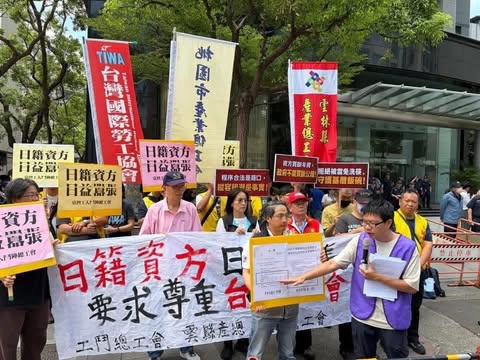
In response to repeated labor disputes involving major Japanese corporations operating in Taiwan, the Taiwan Workers’ Struggle General Confederation (臺灣工人鬥陣總工會), Yunlin Confederation of Trade Unions (雲林縣產業總工會), Taoyuan Confederation of Trade Unions (桃園市產業總工會), and the Taiwan International Workers’ Association (台灣國際勞工協會) jointly held a press conference at the Japan–Taiwan Exchange Association on May 25. The organizations called on Japanese companies operating in Taiwan, including Bridgestone and AGC, to comply with Taiwan’s Labor Standards Act and Mass Redundancy Protection Act and to engage in good-faith negotiations with labor unions.
Ultimately, Taiwanese workers are not demanding special treatment. Rather, they are seeking transparency, respect for collective bargaining, and meaningful participation in decisions that affect their livelihoods. As Japanese corporations continue restructuring their global operations and pursuing new opportunities in emerging industries, they must also fulfill their social responsibilities and respect workers’ rights. The handling of these labor disputes will not only shape labor-management relations within individual companies, but may also influence the long-term trust that underpins Taiwan-Japan economic cooperation and broader social relations.