
Terminology Note: In this article, “Micron Taoyuan Union” refers to the Micron Technology Taiwan Enterprise Union, while “Micron Taichung Union” refers to the Micron Memory Taiwan Enterprise Union. For readability, the abbreviated terms “Micron Taoyuan Union” and “Micron Taichung Union” are used throughout the rest of this article.
The dispute in Taiwan over profit-sharing at Micron, an American semiconductor company, continues to escalate. However, amid management’s various divide-and-conquer tactics and mounting pressure on workers, the struggle is likely to become a protracted one. This article first provides a timeline of the major developments in the Micron labor dispute, followed by an account of the key events and controversies.
Timeline of the Micron Labor Dispute
Micron Taoyuan Union held its first mediation session with management.
The company unilaterally announced its proposal. It was estimated that all the benefits offered would amount to only 4–5% of operating income.
Micron Taichung Union held its first mediation session with management. A second session was scheduled for October 22.
Micron Taoyuan Union held its second mediation session. Mediation failed, and the union initiated a strike ballot.
Micron Taoyuan Union’s strike ballot passed, granting the union the legal right to strike. Approximately 2,000 members voted, with 99% voting in favor.
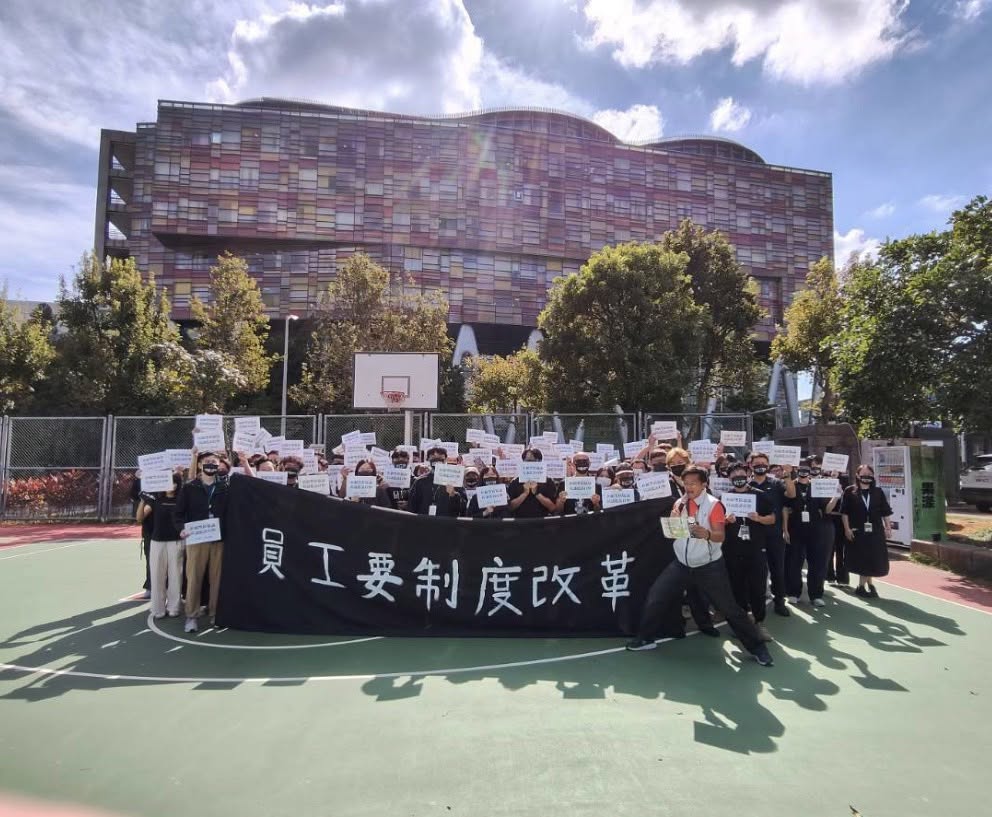
The Taiwan Workers’ Struggle Confederation organized a protest under the slogan “Realizing the AI Dividend and Sharing Economic Gains.” Micron union members joined the action. Micron Taoyuan Union announced a one-day symbolic strike for October 22 in solidarity with Micron Taichung Union ahead of its October 22 mediation session with management.
Micron Taichung Union entered into last-minute negotiations with management and reached an agreement. However, the two parties publicly stated that they had signed a confidentiality agreement and declined to disclose the terms of the deal.
The company held an online all-employee briefing to explain its revised proposal. Micron Taoyuan Union changed its planned one-day strike into a strike involving eleven union officers, allowing members to attend the company briefing. It also held an in-person membership vote to determine whether members accepted the company’s proposal. The results showed that 99% of voting members opposed the proposal. On the same day, management and Micron Taoyuan Union held their first negotiation session since the union obtained the legal right to strike, but failed to reach an agreement. The company’s revised proposal was still estimated to represent only 4–5% of operating income, although it formalized the one-time bonuses announced in September.
Dissatisfied with the conduct of Micron Taichung Union officers, union members joined forces with Micron Taoyuan Union to initiate the formation of the Micron Affiliated Enterprise Union.
Management and Micron Taoyuan Union held their second negotiation session since the union obtained the legal right to strike. No agreement was reached.
In response to questions from Micron Taoyuan Union members and Micron Taichung employees regarding the “no-strike clause” signed by Micron Taichung Union officers and management, which reportedly exceeded the three-year limit stipulated under the Collective Agreement Act, the Ministry of Labor responded that the arrangement was not a collective agreement but a “general agreement,” and therefore did not violate the law.
Management and Micron Taoyuan Union held their third negotiation session since the union obtained the legal right to strike. No agreement was reached. The next session was scheduled for November 17. During the meeting, management accused union members of leaking confidential information and called for law enforcement authorities to investigate.
Prosecutors and investigators summoned several Micron Taoyuan Union members, including union Secretary-General Wei Yu-ling (魏毓綾). Wei was released on bail pending further investigation, with bail set at NT$100,000—a record-high bail amount in Taiwan’s labor movement.
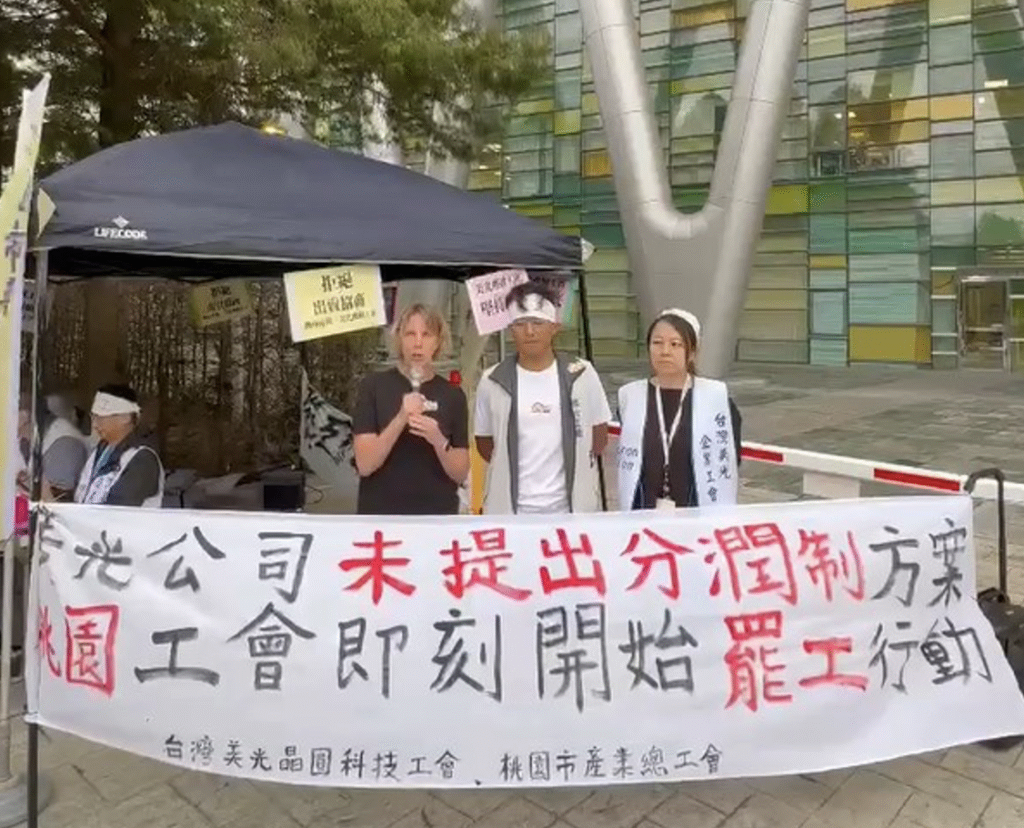
Micron Taoyuan Union issued an open letter stating that the company had pressured individual employees into signing personal agreements and waiving their right to pursue future labor disputes in order to receive the benefits announced by the company. Numerous employees had been summoned individually by management, creating an atmosphere of extreme fear among rank-and-file workers. Given the division between Taoyuan and Taichung, as well as the government’s deliberate obstruction of the formation of an affiliated enterprise union, Micron Taoyuan Union stated that its members should not be left to shoulder the pressure alone. It therefore announced its withdrawal from the November 17 negotiations and declared that it would hold a press conference outside the headquarters of the ruling Democratic Progressive Party (DPP) on the same day, condemning the ruling party for shielding Micron during the labor dispute.
Micron Taichung Union Halted Its Strike Process on October 21, One Day Before Scheduled Mediation
On October 19, the Taiwan Workers’ Struggle Confederation, a labor federation representing workers across different industries, mobilized approximately 2,000 workers to demand higher employer contributions to labor retirement funds and the establishment of a fair profit-sharing system by the government.
Micron employees also participated in the demonstration. At the event, Micron Taoyuan Union announced that it would stage a one-day strike on October 22 to support Micron Taichung Union, which was scheduled to negotiate with management that day. The move was also intended to put additional pressure on the company.
Unexpectedly, however, the announcement of Micron Taoyuan Union’s planned one-day strike on October 22 triggered a series of developments. On October 21, just one day before the originally scheduled mediation session, Micron Taichung Union and Micron management entered into last-minute negotiations. They subsequently announced that they had reached an agreement and withdrew from the mediation process. In effect, Micron Taichung Union brought its strike process to an abrupt halt.
Micron Taoyuan Union Stands Firm
This unexpected move not only caught Micron Taoyuan Union off guard but also provoked intense dissatisfaction among many Micron Taichung Union members.
The reason was that Micron Taichung Union’s officers cited a confidentiality agreement between the two parties, meaning union members were not allowed to know what had actually been negotiated, let alone whether they agreed with management’s proposal.
Union members questioned whether union officers had disregarded democratic procedures and betrayed the union at a critical moment. Some even referred to them as “Judases who betrayed 10,000 members.”
Meanwhile, management had scheduled an all-employee briefing for October 22 to explain its proposal. In response, Micron Taoyuan Union decided to replace its planned collective one-day strike with a strike involving 11 union officers, allowing members to attend the company’s briefing. The union also organized a membership vote that day to determine whether employees accepted the company’s proposal.
After a full day of voting, 1,633 Micron Taoyuan Union members voted against the proposal, accounting for 99% of all votes cast.
The following day, October 22, Micron Taoyuan Union held its first negotiation session with management since obtaining the legal right to strike. The union conveyed members’ opposition to management’s proposal, but the negotiations ended without an agreement.
The two sides held a second negotiation session on October 27. Micron Taoyuan Union demanded that management disclose the actual profit-sharing percentage under its proposal. Management, however, claimed that U.S. regulations prohibited such disclosure.
At the third negotiation session on November 6, management continued to defer the matter, promising only to provide the calculation methodology at a later date. The two sides scheduled their fourth negotiation session for November 17.
After Betrayal and Complicity: Forming the Micron Affiliated Enterprise Union
In Taichung, at a membership briefing organized by Micron Taichung Union leadership, many members openly and forcefully questioned what authority union officers had to make such a unilateral decision. The officers attempted to suppress members’ dissatisfaction by insisting that a strike would affect the company’s operations.
This response only reinforced the perception that Micron Taichung Union was no longer acting in the collective interests of employees or exercising the authority entrusted to it by its members. Instead, it appeared to have become an extension of management.
Members also learned that the October 21 agreement included a no-strike clause between the union and management. Reports suggested that the clause could remain in effect for as long as ten years. However, because union officers had signed a confidentiality agreement with management, members were unable to confirm its actual duration.
Taiwan’s Collective Agreement Act stipulates that fixed-term collective agreements may not exceed three years. Any term exceeding this limit must be reduced to three years.
The Ministry of Labor, however, stated that the agreement in question would be classified as a “general agreement” and therefore would not be subject to this restriction.
Labor organizations argue that this interpretation not only ignores reality but also gives employers a loophole through which they can circumvent the Collective Agreement Act. If provisions that violate the rules governing collective bargaining can simply be legalized by labeling them “general agreements,” what would remain of the legal protections governing collective bargaining? This controversy remains unresolved.
There is a significant difference in the size of Micron’s operations in Taoyuan and Taichung. Taoyuan currently employs approximately 3,000 workers, of whom more than 2,000 are union members. Taichung, by contrast, employs approximately 12,000 workers, with around 10,000 union members. Consequently, Taichung employees remain crucial to exerting meaningful pressure on the company.
Micron Taichung Union members have begun organizing among themselves, launching a petition opposing the union officers’ unilateral decision to terminate mediation and privately reach an agreement with management. They are also demanding that the union convene a general membership meeting to vote on whether to accept the company’s proposal.
In addition, Micron Taichung Union members and Micron Taoyuan Union are working together to establish the Micron Affiliated Enterprise Union. More than 6,000 Taichung employees have joined the initiative so far, representing over half of Micron Taichung Union’s membership.
Once established, the Micron Affiliated Enterprise Union would no longer be restricted to a single factory or worksite. Employees at Micron facilities in Taoyuan, Taichung, and other parts of Taiwan would all be eligible to join. This would break the situation in which management can effectively constrain the collective bargaining power of workers simply by controlling Micron Taichung Union.
However, the Taoyuan City Government and the central Ministry of Economic Affairs are currently using administrative and technical procedures to obstruct the establishment of the Micron Affiliated Enterprise Union.
Mounting Pressure, Judicial Suppression, and Micron Taoyuan Union’s Withdrawal from Negotiations
Although management has continued negotiations with Micron Taoyuan Union, it has simultaneously applied pressure on multiple fronts.
Externally, media reports have increasingly featured anonymous sources claiming that, because of Micron Taoyuan Union’s actions, management would halt its expansion plans in Taoyuan and relocate its investments to Singapore. Although the company has publicly denied these claims, Micron Taoyuan Union has already been portrayed as responsible for undermining Taiwan’s semiconductor industry. Some have even gone so far as to insinuate that Micron Taoyuan Union and its parent organization, the Taoyuan Confederation of Trade Unions (TYCTU), are working on behalf of China to hollow out Taiwan’s semiconductor industry.
Internally, management has summoned large numbers of union members individually, pressuring Taoyuan employees to sign personal agreements with the company and waive their right to pursue future labor disputes. Otherwise, they would not be eligible to receive the benefits publicly announced by the company.
Meanwhile, during the November 6 negotiation session, management accused the union of leaking confidential information and called for prosecutors and investigators to intervene. On November 10, law enforcement authorities summoned several union members and Secretary-General Wei Yu-ling. Wei was ordered to post NT$100,000 in bail pending further investigation. This is the highest bail amount ever imposed in Taiwan’s labor movement.
Under intense pressure from both management and the government, Micron Taoyuan Union issued a public statement on November 12, declaring that it could no longer bear such pressure on its own. It therefore decided to withdraw from the November 17 negotiations.
On the same day, the union announced that it would hold a press conference outside the headquarters of the ruling Democratic Progressive Party, accusing the government of shielding Micron management by allowing it to reach opaque agreements with a small number of union officers, bypassing collective bargaining procedures and depriving Micron Taichung Union members of their right to fight for better benefits. The union also accused the government of cooperating with management in using the judicial system as a tool to suppress Micron Taoyuan Union.
Nevertheless, even though Micron Taoyuan Union has withdrawn from negotiations, employees in both Taoyuan and Taichung remain committed to establishing the Micron Affiliated Enterprise Union and consolidating the collective strength of workers across different cities. For the unions, this labor dispute is far from over. Instead, it is entering a prolonged struggle. Many more challenges may lie ahead before a meaningful victory can be achieved.
Management’s Proposal: No Meaningful Progress
Management’s Proposal: No Meaningful Progress
As the dispute continues to escalate, Micron management has repeatedly promoted its employee benefits package, claiming that it already incorporates a profit-sharing mechanism, that the figures can be easily calculated without any room for opaque or undisclosed arrangements, and that the comprehensive benefits will significantly increase employee compensation.
However, based on the information gradually disclosed and independently examined by union officials and the Taiwan Political Economy Collaborative (共力研究社), the proposed distribution amounts to only approximately 4% of operating income.
This is significantly below the union’s demand of 15%, as well as the approximately 10% profit-sharing levels at companies such as Samsung and SK Hynix. Furthermore, substantial portions of the proposal remain subject to management’s discretionary adjustments.
Below is a brief breakdown of the benefits package currently proposed by management. Management’s proposal can generally be divided into five components: Profit Bonus, a revised IPP system, cash awards, stock awards, and compensation improvements.
1. Profit Bonus
The Profit Bonus is distributed quarterly. The formula for employees in Taiwan is:
Explanation:
- NT$3.75 billion: This figure is calculated by taking the average quarterly value of the one-time NT$1 million bonus paid to each employee in 2026 as a result of union action, then multiplying it by Micron’s 15,000 employees across Taiwan.
- Quarterly Adjusted Profit: Quarterly after-tax operating income minus capital expenditures for the following quarter.
- US$16.5 billion: The average quarterly adjusted profit across the four quarters of fiscal year 2026.
This means that management’s future profit-sharing payments will be anchored to the one-time bonus paid in 2026. But if future adjusted profits perform better than in 2026, the distribution will not increase proportionally. Instead, only 70% of the growth rate will be reflected in the bonus. Furthermore, the basis for calculating the distribution is neither operating income nor net income. It is after-tax operating income minus capital expenditures for the subsequent quarter.
For example, if adjusted profit in a future quarter reaches 1.1 times the 2026 quarterly average, the total profit-sharing payment for Taiwanese employees will not be 1.1 times the one-time bonus paid in 2026. It will only be 1.07 times that amount.
In addition, according to the information disclosed by management, if future adjusted profit falls below the 2026 level, the formula above will not apply. Instead, the bonus will be reduced proportionally according to adjusted profit and then multiplied by 70%.
For example, if adjusted profit in a future quarter is only 0.5 times the 2026 level, the profit-sharing payment will not be 0.5 times the 2026 bonus, nor will it be 0.65 times the bonus as calculated using the first formula (1 + 0.7 ×(-0.5)=0.65 ). Instead, it will be reduced to 0.35 times the 2026 bonus (0.7 ×0.5=0.35).
Since the distribution is discounted regardless of whether future adjusted profits increase or decrease relative to 2026, the future profit-sharing ratio will never exceed the distribution ratio represented by the 2026 one-time bonus, which accounted for no more than 2% of operating income.
2. Revised IPP System
The formula for Taiwan’s IPP is:
Management will retain the IPP system as a performance-based incentive.
The key difference from the previous system is that the core component, the “Performance Achievement Rate,” will now be determined entirely by the “Strategic Achievement Rate,” rather than being determined equally by profitability and performance achievement as before. In other words, this change will make the IPP system even more disconnected from the company’s actual profit performance.
Although the company claims that the upper limit of the Performance Achievement Rate will increase from the previous 200% to 250%, and that individual employees may receive a performance multiplier of up to 500%, all of these percentages remain entirely at management’s discretion.
According to the formula, if the Performance Achievement Rate reaches 250% and the Individual Performance Multiplier reaches 500%, employees could receive the equivalent of 31.5 months of monthly salary. If all Micron employees worldwide received this amount, the total distribution would account for 5% of operating income in 2026.
However, if the Performance Achievement Rate remains at the usual 100% and the Individual Performance Multiplier also remains at 100%, employees would receive only 2.5 months of monthly salary. If all Micron employees worldwide received this amount, the total distribution would account for just 0.4% of operating income in 2026.
Given that the company retains complete discretion over these adjustments, employees and the public should reasonably regard IPP as a distribution accounting for less than 1% of operating income, and potentially even less than 0.5%.
3. Cash Incentives (Max Out)
Cash incentives are distributed every six months, with a target of 10% of annual salary per payment, or 20% in total over the year. However, the actual amount is subject to individual performance adjustments.
Assuming employees meet their targets across the board, the average employee worldwide would receive approximately an additional 2.8 months of salary. This would account for approximately 0.5% of Micron’s 2026 operating income.
4. Stock Awards (RSUs)
Restricted Stock Units (RSUs) are limited to employees above certain job levels, with the award value varying according to seniority.
For the sake of comparison, if all employees worldwide received US$16,000 worth of stock annually, based on the company’s 2026 policy announced in September, the total value would account for approximately 1% of 2026 operating income.
However, since these awards are restricted to certain job levels and management has not committed to a fixed amount, this estimate is inevitably an overstatement.
5. Compensation Adjustments
These adjustments are unrelated to profit-sharing or individual performance. They are part of the company’s overall compensation policy and include:
- Three additional days of annual leave.
- An increase in the employer’s labor pension contribution equivalent to 2% of salary.
- An increase in shift allowances, up to NT$4,000 or 5% of salary.
The financial value of these adjustments is relatively small. Even if all employees worldwide received the same level of benefits, their combined value would account for only approximately 0.1% of 2026 operating income.
Micron Still Offers Workers Only 4% of Operating Income and The Labor Dispute Continues
Taken together, all of the above benefits amount to approximately 4% of Micron’s 2026 operating income. If profits increase in the future, this percentage will shrink even further because the only component directly linked to profitability, the Profit Bonus, will represent a progressively smaller share of operating income as profits rise. This is far below the union’s demand of 15% of operating income and also below the approximately 10% profit-sharing levels at Samsung and SK hynix.
Furthermore, since the Profit Bonus is anchored to the one-time bonus announced in September 2026, there will be no additional profit-sharing payment for 2026. The other components of the proposal are also barely different from the package announced by the company in September. That earlier benefits package already accounted for approximately 4–5% of operating income (see What You Need to Know About the Potential Strike at Micron Taiwan). This means that since the union initiated strike proceedings, management has made no substantial improvements beyond formalizing the various bonus schemes it had already proposed in September. Under these circumstances, the Taichung Union’s decision to compromise before mediation is even more difficult to justify. Regardless of whether they are based in Taoyuan, Taichung, or elsewhere, most employees still find the proposed package unacceptable. The struggle will continue, even if victory is not decided through an immediate strike.