
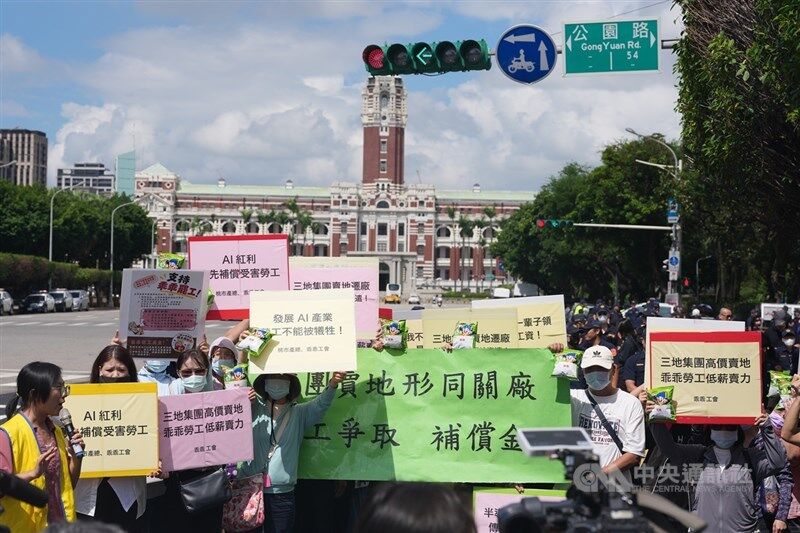
When a union goes on strike, who has the right to decide whether migrant workers should continue working? On October 2, 2026, the union at Kuai Kuai Co., a Taiwanese snack brand, launched a strike. Labor brokers unscrupulously led migrant workers in an attempt to cross the picket line and enter the factory. They even made migrant workers face a camera one-by-one and declare whether they were willing to work. On the surface or in the videos, it might appear that the migrant workers were making their own individual choices. But when brokers are involved in overseeing workers’ employment arrangements, accommodation, and everyday lives, how exactly free are migrants to make their own choices?
The strike exposed a frequently overlooked problem in Taiwan: labor brokers do more than help migrants workers find jobs. They can also intervene in labor disputes and undermine collective union action. When migrant workers depend on brokers to maintain their employment and daily lives, can they refuse unreasonable demands or participate in a strike without facing pressure or intimidation? The Kuai Kuai strike brings this question into sharp focus.
The Strike Behind the Tech Industry’s Protective Talisman
Kuai Kuai is a Taiwanese snack brand launched in 1968 that remains a household name with significant cultural meaning. Because its name (乖乖) in Mandarin means well-behaved or obedient, people began placing its snacks on machines and equipment in the 2000s as protective talismans, manifesting smooth operation. The practice gradually became a distinctive part of Taiwanese culture, particularly in the technology industry, where Kuai Kuai is regarded as a good luck charm of sorts.
Yet the brand symbolizing good luck became the center of a labor dispute triggered by a factory relocation. Originally a family-owned business, Kuai Kuai was sold in 2019 to the San-Ti Group, a Taiwanese conglomerate that got its start in real estate and land development, after years of poor management and internal family disputes.
In July 2026, the San-Ti Group sold Kuai Kuai’s factory site in Zhongli, Taoyuan to ASE Technology Holding, a major semiconductor company seeking to expand its advanced packaging capacity for artificial intelligence (AI) applications. The transaction was valued at NT$5.67 billion. Previously, Kuai Kuai had manufactured its products in Zhongli for decades, becoming a notable part of the manufacturing hub. ASE is a rapidly expanding company with factories dotting Zhongli’s industrial park. The acquisition is not unique. Over the last two years, many older traditional manufacturing firms across Taiwan have been closing factories and selling valuable land to electronics companies [1].
Although the San-Ti Group retained control of Kuai Kuai’s operations through a sale-and-leaseback arrangement, it announced plans to relocate the factory. This led workers unclear about their job security. Management repeatedly failed to adequately address employees’ concerns about their future, ultimately prompting the union to strike. For employees, this was not simply a property transaction or a change in corporate strategy. It directly affected whether they could keep their jobs, whether their years of service would be recognized, and what would happen to them after the relocation.
Strike Picket Lines: Preventing Agency Workers from Entering the Factory
Kuai Kuai has operated a factory in the Zhongli Industrial Park for 57 years. Many employees have worked there for 20 to 30 years, and more than one-third have over 25 years of service. Despite their long tenure, they have continued to receive wages close to the minimum wage. Although the factory had a union, the San-Ti Group did not consult it before selling the land. Shockingly, employees learned of the transaction only after it was reported in the news.
With the planned relocation threatening their livelihoods, many middle-aged and older workers faced the risk of losing their jobs. The union therefore demanded compensation for the factory closure. Approximately 160 Taiwanese workers and 60 migrant workers from Vietnam and Indonesia were affected. All Taiwanese employees belonged to the union, while the migrant workers had not joined. While migrant workers are legally allowed to join unions, there are many reasons they do not, ranging from fear of retaliation from brokers and employers, language and cultural barriers, and even discrimination from local workers.
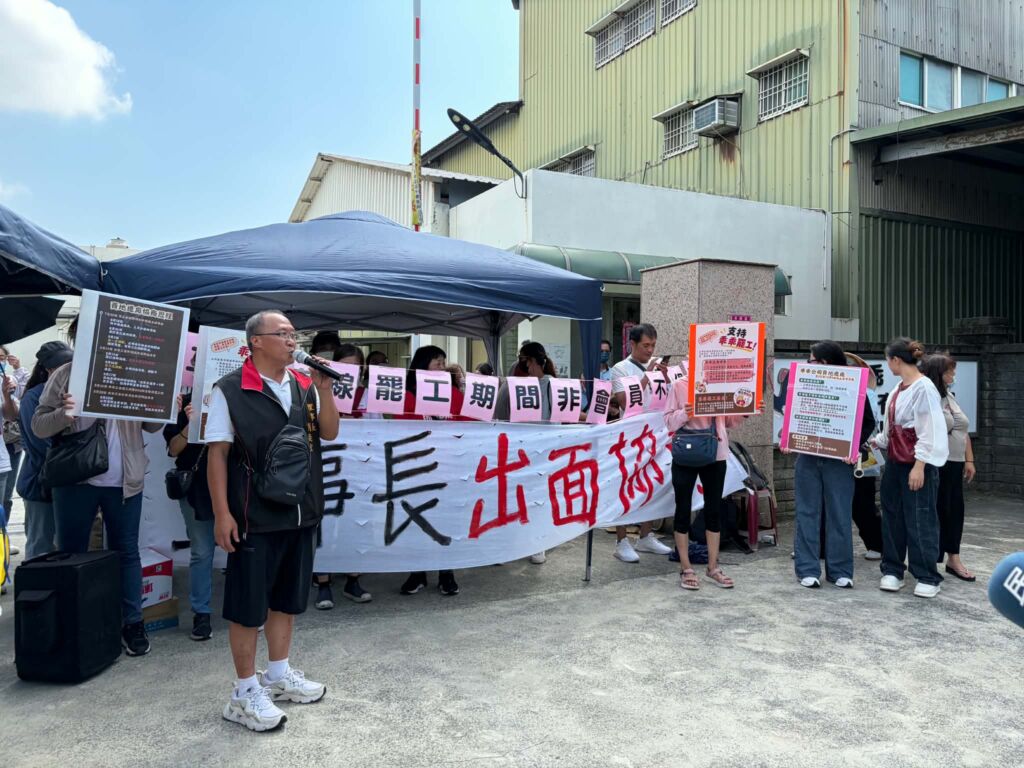
Following statutory mediation and a strike ballot, the union officially launched its strike on October 2. At 5 a.m. that day, union members established picket lines at the factory’s main, side, and rear entrances. As the migrant worker dormitory was located within the factory compound, the rear doors happened to be the entrance into both the factory and their living facilities. While the union had not necessarily intended to restrict migrant workers’ movement, they were cognizant that migrant workers could enter the factory directly from their dorms, and wanted to prevent Kuai Kuai management from weakening the strike by coercing migrants to maintain production.
Brokers Attempt to Break Through the Picket Lines and Threaten Wage Deductions to Compel Migrant Workers to Report for Duty
Around 7 to 8 a.m. on October 2, a labor broker who also supervised the migrant workers’ dormitory led approximately 30 migrant workers from the rear entrance around to the factory’s main entrance in an attempt to get them inside to work. Blocked by union members, the broker and migrant workers had to wait nearby. The Vietnamese broker initially appeared uncertain about how to respond and did not directly confront the union. When the union chairperson demanded that the broker stop threatening workers with wage deductions to force them to report for duty, the broker repeatedly agreed. After union members urged the migrant workers not to enter the factory, the workers returned to their dormitory to rest.
At around 9 a.m., however, the situation changed. The migrant workers were instructed to change into their work uniforms and a Taiwanese broker arrived at the picket line outside the main entrance. The two brokers began filming the workers one by one, requiring each to declare on camera whether they were willing to enter the factory and work. The Taiwanese broker, despite not being a Kuai Kuai employee, even shouted at the union and demanded that the migrant workers be allowed to enter. Union members confronted the brokers, asking on what grounds they could enter the factory and demand that migrant workers declare their intentions on camera.
For the union, this was not merely a question of who could enter the factory. It was also about whether brokers had the authority to intervene in migrant workers’ employment decisions and whether workers could decide their position in the labor dispute free from coercive pressure.
Union representatives also raised serious occupational safety concerns. Restarting production required someone to operate the boiler, a task requiring specialized training and certification. The factory’s only two qualified employees were both participating in the strike. Ordering untrained migrant workers to resume production or operate the boiler would create serious safety risks. Migrant workers normally worked alongside Taiwanese employees. If required to work during the strike, they might also have to take on duties ordinarily performed by their Taiwanese colleagues, potentially placing them in situations beyond their training and experience. If workers made operational errors or suffered injuries because they could not understand Chinese-language labels, lacked professional training, or had no experience with assigned tasks, who would be held responsible?
Neither broker could provide a convincing answer. Ultimately, the migrant workers did not insist on entering the factory or attempt to force their way through the picket line. The brokers had no choice but to take them away. The incident demonstrated how brokers can intervene and coercively leverage migrants to alter power struggles between labor and management in favor of the latter.
Brokers Are More Than Just Intermediaries
In Taiwan, many migrant workers must pay brokerage fees and rely on brokers to obtain employment. After arriving, they may also depend on brokers for accommodation management, work-related information, and everyday assistance. Even when brokers are not legally recognized as employers, they can exercise substantial power in practice. Refusing a broker’s demand may mean more than rejecting a work assignment: workers may fear consequences for their employment, accommodation, or daily lives.
On the day of the strike, the Taiwanese broker told migrant workers that they would not receive wages if they did not work. However, brokers cannot unilaterally determine whether wages are paid. The Kuai Kuai union stated that even though the migrant workers were not union members, the employer should not require them to enter the factory and risk their safety without proper training and safeguards. The union also pledged to assist if management withheld wages or made improper deductions. This case illustrates how brokers may exploit migrant workers’ dependence on their jobs and income to intervene in labor disputes and undermine a strike.
In Taiwan’s labor laws and administrative practice, brokers are often regarded as intermediaries who facilitate employment arrangements. Yet, based on unions’ experiences in labor disputes, brokers are not necessarily neutral actors. Through their influence over employment, accommodation, and access to information, they may accommodate employers’ interests and further restrict workers’ freedom of choice. The issue, therefore, extends beyond the conduct of individual brokers. It concerns the power structure created by the brokerage system itself.
Being Exempt from Brokerage Fees Does Not Mean Being Free from Forced Labor
Forced labor cannot be assessed solely by whether migrant workers have paid recruitment or brokerage fees. Even when workers do not have to pay these fees, they may remain vulnerable to pressure and control if they depend on brokers for employment, residency, and everyday needs. Eliminating brokerage fees is important, but it does not necessarily remove the systemic constraints workers face when making employment decisions.
During a strike, brokers’ intervention can turn the decision to report for duty into part of the power struggle between labor and management. When workers must face brokers who manage aspects of their daily lives and declare on camera whether they are willing to work, their stated intentions do not necessarily reflect genuine freedom of choice. A single incident is not enough to establish that all the conduct involved constitutes forced labor under applicable law or international standards. Nevertheless, the case raises an important question: when migrant workers find it difficult to refuse a broker’s demands because they fear losing their jobs, income, or basic living arrangements, do they truly have the freedom to refuse work?
It also raises questions about migrant workers’ labor rights, including their freedom to join a union, decide whether to work during a strike, and participate in collective action in accordance with the law. If migrant workers formally possess the right to choose but cannot exercise it freely because of their dependence on brokers, those rights remain incomplete in practice.
Migrant Workers’ Rights Are in the Interests of All Workers
On October 6, following approval of an agreement at a union membership meeting, the Kuai Kuai union signed an agreement with the company, bringing the strike, which had lasted more than five days, to an end. The union secured additional compensation and a no-free-rider clause.
Although the agreement addressed Taiwanese workers’ demands for job security and compensation, the strike raised a broader question that the Taiwanese government and the international community must take seriously: Will we allow the brokerage system to continue undermining workers’ right to organize and engage in collective action?
As Taiwan’s migrant worker population continues to grow, this is not merely a migrant worker issue. Taiwanese and migrant workers share the same labor market, and their rights and collective power are closely interconnected. When migrant workers cannot freely refuse unreasonable demands or participate in collective action without interference, the collective strength of all workers is weakened. Kuai Kuai may serve as a talisman for keeping Taiwan’s tech industry running smoothly, but what truly protects workers is not a packet of snacks. It is a system that safeguards every worker’s rights, regardless of nationality.
[1]
Amid the AI wave, four strikes highlight the sins of traditional industries