
TSMC is undoubtedly the most critical company in Taiwan, often revered as the “sacred mountain protecting the nation,” or 護國神山 in Mandarin [1]. Currently, TSMC commands roughly 70% of the global foundry market and produces over 90% of the world’s advanced semiconductor chips, thereby holding a near-monopoly on in-demand, AI chips.
An inextricably-linked relationship between the Taiwanese state and TSMC
Since its founding, 48% of TSMC’s financing came from the National Development Fund in Taiwan, serving as a landmark milestone for Taiwan’s entry into the semiconductor industry. Today, TSMC has grown into the world’s 6th largest company by market capitalization, accounting for over 40% of the Taiwanese stock market. Even at this massive scale, the Taiwanese government still retains a 6.38% stake, remaining TSMC’s largest shareholder. In this capacity, the Taiwanese government appoints representatives to TSMC’s board of directors.
However, it would be inaccurate to describe the relationship between TSMC and the Taiwanese government as one-sided, with the former exercising direct control over the latter. Given TSMC’s profound impact on industrial development, capital markets, transnational supply chains, and even geopolitics, it is more accurate to say that the Taiwanese government, ostensibly representing Taiwan as a whole, exists in an inextricable, symbiotic relationship with TSMC.
TSMC’s success in the chip market emerges from its capture of the contract foundry scene, in which it builds and runs state-of-the-art ‘fabs’ (chip factories) to produce semiconductors for other fabless companies that design their own chips but lack the manufacturing facilities. Relentlessly pursuing miniaturization, higher yields, and maximum efficiency, TSMC has established itself as the go-to for high-margin chip design firms such as Apple, Nvidia, and Qualcomm. Propping up TSMC’s market dominance is the company’s massive, year-over-year, capital investments and a high-quality engineering workforce. By pushing contract manufacturing to its absolute limit, TSMC has built an unassailable moat for itself in the AI era.
Concerning working conditions, in Taiwan and the United States
As the leader of the global chip industry and Taiwan’s most powerful exporter, TSMC offers compensation packages that are widely regarded as the best in Taiwan. Most of its white-collar employees graduate from top-tier universities, and frequently forge connections with the company through a variety of university-industry programs. Yet, despite the sky-high salaries and bonuses, deep-seated controversies related to its workforce persist within the company.
First, uninterrupted and hyper-efficient production relies upon excruciatingly long working hours, often bleeding into off-hours or weekends. With regards to company culture, employees are expected to return to the fab at a moment’s notice to handle emergencies. Early this year, the Taiwanese labor coalition, Dignified Labor Law Reform Alliance, revealed that TSMC ranked 7th amongst Taiwanese companies which were penalized for violating the Labor Standards Act [2]. Every single breach was tied to Article 32, Paragraph 2 of the Act, which regulates extended working hours. Essentially, such transgressions mean that TSMC employees often work over 12 hours a day (including regular hours), or exceed 46 hours of overtime in a single month.
Furthermore, TSMC has long been notorious for its strict culture of hierarchy and obedience. Superiors wield total control over subordinates. Coupled with individualized accountability, this creates a high-pressure, hyper-centralized management culture designed to maintain peak efficiency. When TSMC announced plans to build plants in Arizona, public opinion in Taiwan generally dismissed any threat of US plants outcompeting Taiwan. The reasoning was simple: American engineers would never tolerate the awful working conditions that Taiwanese workers endure.
Most critically, just as the chip industry’s offshoring from the United States to Asia decades ago was driven by the quest for cheap, highly efficient, and non-unionized labor, TSMC continues to enforce a strict anti-union policy today, forbidding employees from organizing.
However, multiple fatal industrial accidents have recently occurred at construction sites under TSMC’s recent rapid expansion plans. While TSMC avoids direct employment liability, it is the mega-proprietor commissioning these projects, meaning all construction must comply with its standards. Yet, TSMC tacitly allows contractors to use complex, multi-tiered subcontracting schemes. This practice shifts the grueling pressure of tight deadlines onto the bottom-tier construction workers, while allowing the company to shirk responsibility and shift the blame to individual worker negligence whenever a fatal accident occurs.
A letter to the shareholders
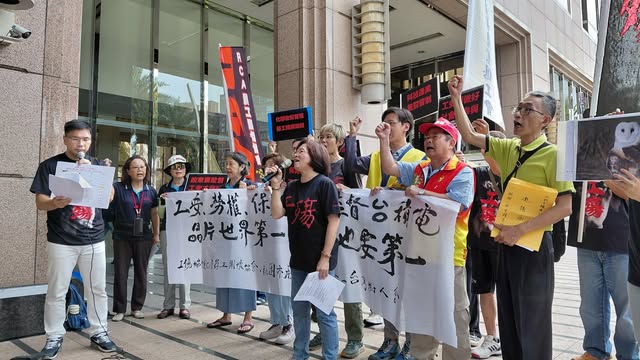
On June 4, 2026, several labor rights organizations gathered outside the TSMC annual shareholders’ meeting to voice their demands and publish an open letter to the shareholders. The contents of the letter are as follows:
Dear TSMC Shareholders:
We are a coalition of labor and industrial accident victim advocacy groups deeply concerned with TSMC’s occupational safety, labor rights, and supply chain human rights. We stand outside the shareholders’ meeting today not to oppose TSMC’s success, but because TSMC is a world-class enterprise. As such, it must adopt world-class standards when addressing worker safety, labor rights, and corporate social responsibility.
Shareholders should look beyond stock prices, dividends, and revenues; they must also examine the systemic risks a company accumulates. Workplace fatalities, grueling hours, out-of-control subcontracting chains, frequent labor law penalties, inadequate prevention of occupational illnesses, and supply chain human rights violations can all severely damage TSMC’s ESG ratings, international client trust, corporate reputation, and long-term shareholder value.
Driven by the booming demand for AI and advanced packaging, TSMC has expanded its plants at a breakneck pace in recent years, triggering massive construction and subcontracting waves. This has resulted in several fatal workplace accidents. These tragedies cannot simply be dismissed as individual carelessness. As the proprietor, TSMC must confront the institutional failures stemming from aggressive expansion, convoluted subcontracting chains, extreme scheduling pressures, and broken on-site management.
At last year’s shareholders’ meeting, the Taiwan Association for Victims of Occupational Injuries presented three demands to TSMC: care for victims of industrial accidents and their families, strengthen autonomous safety management, and establish a truly independent third-party oversight mechanism. This year, we demand concrete answers: Have the families of accident victims received proper consolation and care? Has safety management actually reached the bottom-tier subcontracting workers? Is TSMC willing to publicly disclose industrial accident data, contractor mishaps, improvement tracking, and penalty records?
TSMC’s issues extend past workplace safety. In recent years, TSMC has faced numerous regulatory penalties and controversies regarding working hours, overtime, time-card tampering, and rest days. The high-tech industry is not an extra-legal zone exempt from labor laws. TSMC must stop using long hours and a high-pressure work culture as the price of its competitiveness. It must respect its employees’ rights to organize unions, engage in collective bargaining, and receive fair profit-sharing bonuses.
The RCA Employees’ Care Association also reminds us that the Taiwan tech sector must never forget the blood and tears of the workers who suffered from RCA’s occupational illnesses. As the semiconductor leader, TSMC must learn from the historical lessons of RCA. It must integrate occupational safety, disease prevention, supply chain human rights, workers’ right to know, and information transparency into the core of its corporate governance.
We call on all shareholders to join us in demanding that TSMC:
- Establish a long-term mechanism for consoling, caring for, and financially assisting industrial accident victims and their families.
- Strengthen autonomous safety management and ensure it is strictly enforced down to contractors, sub-contractors, dispatched workers, daily laborers, and migrant workers.
- Establish a genuinely independent, third-party occupational safety oversight mechanism.
- Publicly disclose records of industrial accidents, contractor mishaps, occupational illnesses, regulatory penalties, and subsequent improvement tracking data.
- Rectify systemic issues regarding long working hours, time-card logging, unpaid/excessive overtime, and recurring Labor Standards Act violations.
- Respect employees’ fundamental rights to form unions, engage in collective bargaining, and receive fair profit-sharing.
- Remember the historical lessons of the RCA occupational health tragedy, actively implementing disease prevention and securing workers’ right to know.
- Require the Board of Directors to regularly disclose comprehensive reports on occupational safety, labor rights, human rights, and contractor governance.
TSMC is already number one in the world for chips. We expect TSMC to also become number one in the world for occupational safety, labor rights, human rights, and the prevention of occupational illnesses.
First in chips means being first in responsibility.
Labor Organizations: Taiwan Association for Victims of Occupational Injuries (工作傷害受害人協會), RCA Corporation Employees Caring Association (RCA員工關懷協會), Taoyuan Confederation of Trade Unions (桃園市產業總工會), Taiwan Union of Electronics, Electric, and Information Technology (台灣電子電機資訊產業工會).
Silencing tech workers for the sake of shareholders
Crucially, during the shareholders’ meeting on June 4th, various advocacy groups attempted to speak through shareholder proxies. However, when it was finally the turn of the Taiwan Union of Electronics, Electric, and Information Technology (the organization most directly relevant to tech workers), C.C. Wei, the current CEO of TSMC, abruptly declared the shareholders’ meeting adjourned.
The union infers that this abrupt shutdown was directly linked to TSMC’s recent, unilateral reduction of the employee profit-sharing bonus ratio, as the union’s speaking request explicitly stated its intent to discuss “restoring the bonus ratio and organizing worker unions.” In response, the union published the speech they were barred from delivering [3]:
“Hello, Board of Directors, Shareholders, and especially our fellow partners who are both shareholders and employees. We are the Taiwan Union of Electronics, Electric, and Information Technology, and I am Ho Zhi-yuan (何志元), a member of the union’s board of directors.
Today, advocacy groups representing occupational safety, labor rights, supply chain human rights, and habitat conservation have gathered at the TSMC shareholders’ meeting. We are here because we believe that as the ‘Sacred Mountain Protecting the Nation,’ TSMC cannot solely focus on production capacity, stock prices, and profits. On the contrary, there remains immense room for improvement and a pressing need to address the doubts raised by society.
Recently, TSMC rolled out its 2025 employee profit-sharing distribution. Workers discovered that the profit-sharing bonus ratio was slashed from 12% to 10%. The company is making record profits, yet the workers are getting less? If this is the case, why should employees continue selling their livers, abandoning their families, and sacrificing their children just to work grueling overtime? Infuriated by this unfairness, employees have already begun a ‘Leave on Time Movement.’
Regarding the profit-sharing issue, the Taiwan Union of Electronics, Electric, and Information Technology urges TSMC to do two things:
First, TSMC must restore the profit-sharing ratio of previous years. As the famous line from the movies goes: ‘Whether the Beggar Clan prospers depends not on the Chief, but on the Emperor.’ If TSMC fails to restore the bonuses, it will only foster deep resentment among its workforce. When that happens, who will be left to generate profits for the shareholders and the board?
Conversely, if workers do not apply pressure, how can we expect management to willingly let go of the prime meat clenched between their teeth? This brings us to our second appeal.
Second, TSMC must take a positive, public stance respecting its employees’ right to organize unions. Whether to form a union is entirely the workers’ business. TSMC management should stop putting out statements claiming ‘the company does not encourage unions’ or that ‘unions will drain the company’s energy.’
TSMC employees should seize this momentum to organize a union, turning individual grievances into collective bargaining power to force management to give back what is rightfully ours.
Everyone! Management successfully cut your bonuses this time. If we don’t push back, next time it won’t just be a 2% cut. The corporate charter only mandates distributing ‘1% or more’—the exact amount depends entirely on the board’s mood, completely detached from how much profit the company actually rakes in.
Look at Samsung! With a union, workers can fight for a fair distribution of wealth; without one, you are just waiting to be slowly slaughtered. Which of these two paths will you choose?
If you have any questions about unions, or if you want to organize one but don’t know where to start, you are welcome to contact the Taiwan Union of Electronics, Electric and Technology. We will do our absolute best to assist you.”
Protecting the nation at what cost?
TSMC is not just a “sacred mountain protecting the nation”; it is also gargantuan company placing its tech employees under unfair working conditions. If assigning extreme overtime hours, fostering an abusive management culture, banning unions, and ignoring industrial accidents are normalized on this “sacred mountain,” it is hard to imagine how tech workers across Taiwan can ever achieve a breakthrough in their labor rights, which include the right to organize, right to strike, and right to collectively bargain.
For the aforementioned advocacy groups, risking public backlash is a price they are willing to pay. The goal for these groups is to ensure that Taiwan’s “sacred mountain” is ethically built upon a foundation of robust labor rights. Ultimately, the Taiwanese public should aspire for a future in which the workers behind TSMC and its subcontractors no longer have to bittersweetly acknowledge that it was only through their willingness to be worked to the bone that kept this mountain standing.
[1] The Silenced Shareholder Meeting Speech
[2] Post-conference press release from the Dignity Labor Law Amendment Alliance regarding the top ten employers violating labor laws in 2025
[3] Taiwan’s “Silicon Shield” hypothesis suggests that because the island serves as the world’s most critical semiconductor production hub, foreign powers will be compelled to defend Taiwan against a potential invasion by China.