
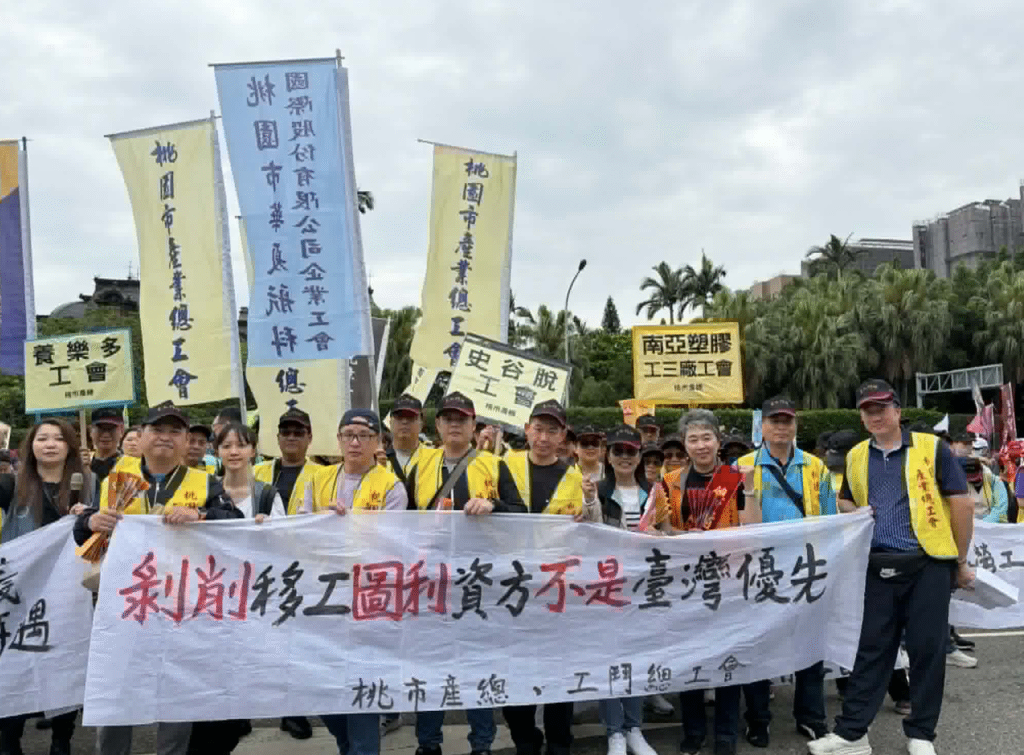
Taiwan’s 2026 rally for May Day, or International Workers’ Day, focused on expanding and improving the nation’s retirement system, highlighting calls to reduce disparities in access to pension funds and insurance [1]. Labor unions and civil society organizations put forward eight major demands, including:
- Gradually increasing the employer contribution rate for the New Labor Pension System from 6% to 12%
- Removing the cap of 45 base units when calculating pension payouts; workers should be paid for every year they have worked
- Under the Old Labor Pension System, workers earn two base units annually for the first 15 years of service, and one base unit annually afterwards; base units are then multiplied by a worker’s average salary upon retirement, and unfortunately, workers are limited to 45 base units
- Raising the ceiling on insured salary levels for labor insurance and labor pensions
- Increasing the cap on severance pay to support unemployed workers
- Expanding universal coverage of social insurance (this includes the coverage of domestic caretaker migrants into the labor insurance system)
- Extending the New Labor Pension System to migrant workers
- Ensuring full funding of retirement and pension systems for civil servants and teachers
- Eliminating differences between the pension systems for teachers at public and private schools
These demands aim to not only enhance retirement protections, but also standardize protections across different types of workers. A crucial issue is the significant gaps in pension and insurance coverage between local workers and migrant workers.
Taiwanese law divides migrant workers into two categories: industrial migrant workers and domestic caretaker migrants. Industrial migrant workers are covered by the Labor Standards Act, so their protections are similar to those of local workers. They are entitled to minimum wage, must be enrolled in social insurance, and legally have access to labor pension rights. However, they are only eligible for the Old Labor Pension System, which requires 15 years of continuous service with the same employer to claim retirement benefits.
Under current regulations, industrial migrant workers are typically hired on three-year contracts, extendable up to 12 years. Only after transitioning to “foreign skilled workers” might they qualify to claim pensions under the old system, yet this requirement often becomes a factor in employers’ decisions about contract renewal. Therefore, this year’s demands call for applying the New Labor Pension System to industrial migrant workers. The new system requires employers to contribute 6% of a worker’s monthly salary into a personal account, eliminating issues related to job changes or interrupted service. Migrant workers would be able to withdraw funds upon reaching retirement age.
Domestic caretaker migrants, by contrast, are excluded from the Labor Standards Act. They lack minimum wage protections, employers are not required to enroll them in labor insurance, and they have no access to labor pension benefits. As such, many organizers at Taiwan’s May Day march firmly demand that employers enroll domestic migrant workers in labor insurance and contribute to their pensions.
Although the government has not yet issued a clear response to these demands, migrant worker rights in Taiwan have come under heightened scrutiny from various civil society organizations and governing bodies in the United States over the past year. For example, the September 2025 crackdown levied by the U.S. Customs and Border Protection in response to forced labor at a major Taiwanese manufacturer [2] and the February 2026 Taiwan–U.S. Agreement on Reciprocal Trade (which requires Taiwan to phase out brokerage fees for migrants and eliminate forced labor) [3], have placed significant pressure on the Taiwanese government to improve migrant worker protections.
However, increased attention to migrant worker rights has also triggered dissatisfaction among employer groups and some members of the public. Tensions began escalating late last year following a case in which migrant workers at TaiDoc Technology Corporation (泰博科技) were dismissed after organizing a union. A small right-wing party, the Taiwan Solidarity Party (台灣團結聯盟, TSP), aligned with TaiDoc’s management to accuse migrant workers of spreading misinformation, alleging that labor rights organizations are externally manipulating disputes. Entrenched in xenophobic ideology, the TSP argues that working in Taiwan is a “privilege” for migrant workers, and that they should not expect to enjoy the same rights as Taiwanese citizens.
In response to the unions’ demands for equalizing protections between migrant and local workers, the Taiwan Solidarity Party has repeatedly voiced fervent and racist opposition. Together with employer and labor broker organizations, they engaged in heated verbal clashes at union press conferences. Evoking America’s fascist, “Make America Great Again” slogan, the TSP advocates for a “Taiwan First” approach, calling on the government to drastically reduce protections for migrant workers and even slandering Taiwan’s May Day rally as an event which supports foreigners oppressing Taiwanese citizens. The TSP also organized a May Day counterprotest in front of the Ministry of Education (citing that “employers are workers too!”) as well as an Employer’s Day Rally in front of the Presidential Office on May 2nd. During the latter, members and supporters of the TSP violently pushed, yelled at, and spat on a few peaceful counter-demonstrators who held placards noting that “the enemy is not migrant workers, but exploitative systems” (“敵人不是移工,是剝削制度”), “migrant workers’ rights are everyone’s rights” (“移工權利,全民權利“), and “labor rights know no borders” (“勞工權利沒有國界”).
The general platform of the TSP includes the following demands:
- Decoupling wages of local and migrant workers
- Abolishing the replacement wait time period
- This replacement wait time period ensures that employers must wait three months to replace a migrant worker who has absconded; this was issued to prevent employers from abusing or arbitrarily dismissing migrants, as well as cycling through migrant workers too quickly
- Opposing employer responsibility for migrant workers’ airfare and brokerage fees
- Requiring migrant workers to pay security deposits
- Restricting migrant workers’ rights to form unions and participate in protests
- Calling for the resignation of the Minister of Labor
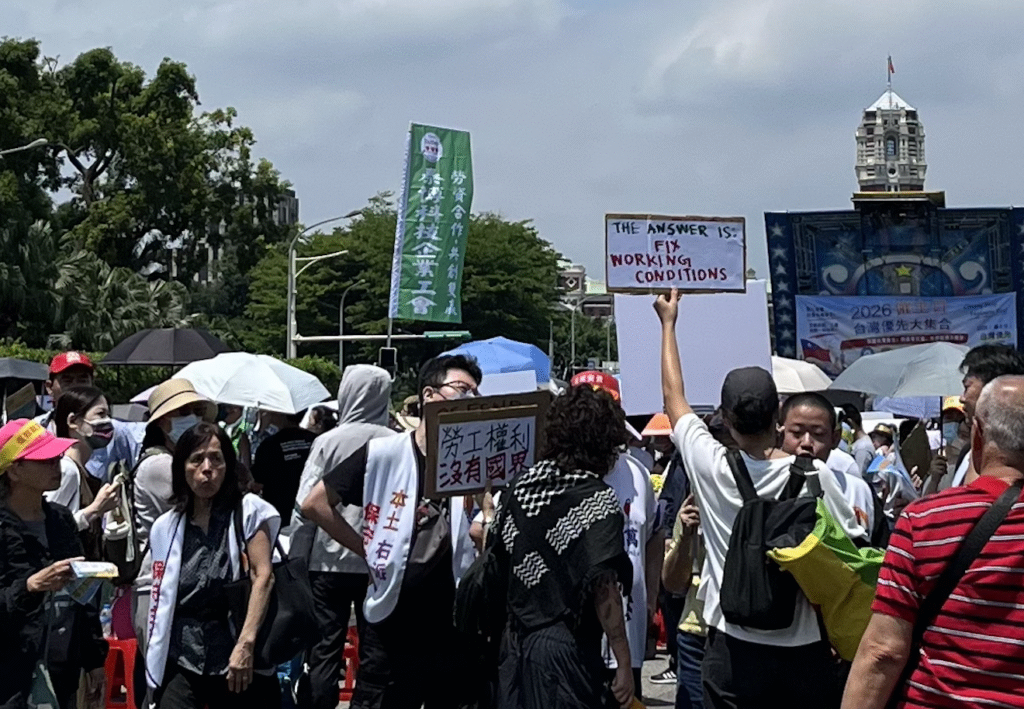
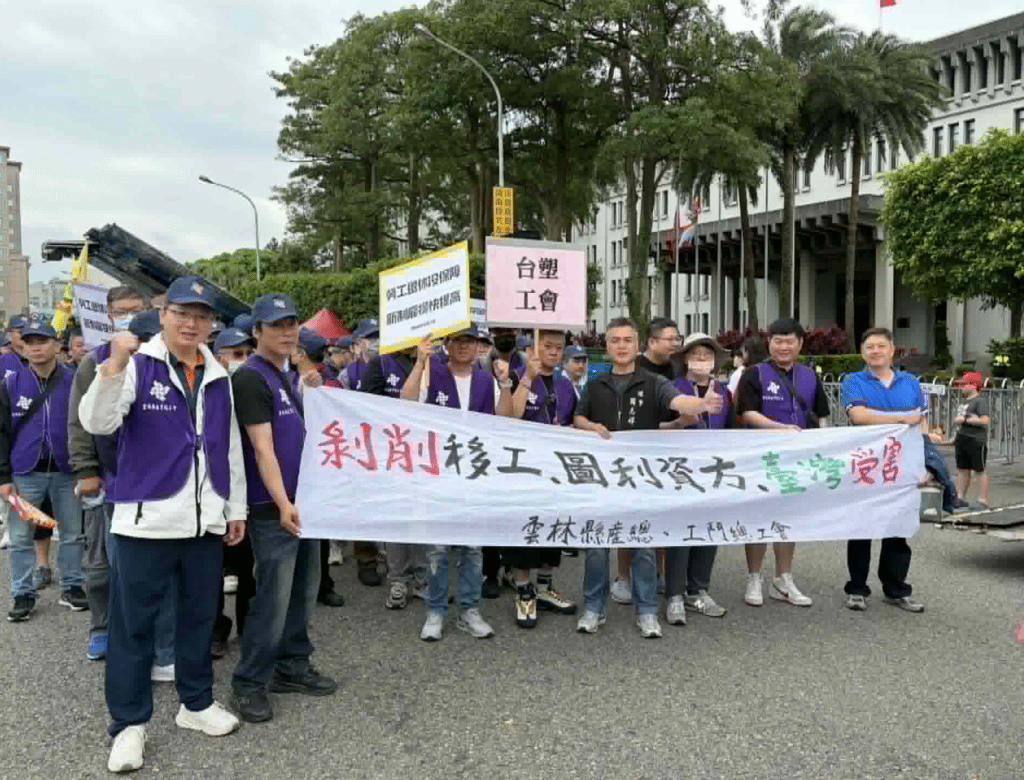
Labor unions have responded strongly to these criticisms and what they see as smear campaigns against migrant workers. For example, the Yunlin County Federation of Trade Unions issued a statement in late April accusing the Taiwan Solidarity Party of distorting facts and exaggerating data about migrant workers’ use of social insurance in an attempt to divide Taiwanese society. During the May Day march, unions argued that the “Taiwan First” slogan in practice means “Employers First,” noting that the party has never supported key labor issues such as pension security, wage increases, or reduced working hours.
Although the May Day rally appeared to have greater public visibility than the opposing protest, skepticism toward migrant worker rights promoted by the Taiwan Solidarity Party and employer groups has spread widely. Social media has been flooded with falsities based in racist and discriminatory views, such as: migrant workers come to Taiwan when they are sick to exploit health insurance; migrants worsen public safety; migrants receive large childbirth subsidies; and migrants (particularly from India) will increase rates of sexual crime. The widespread circulation of such misinformation has even prompted the Ministry of Labor to release videos debunking these claims, indicating the government can no longer ignore the issue.
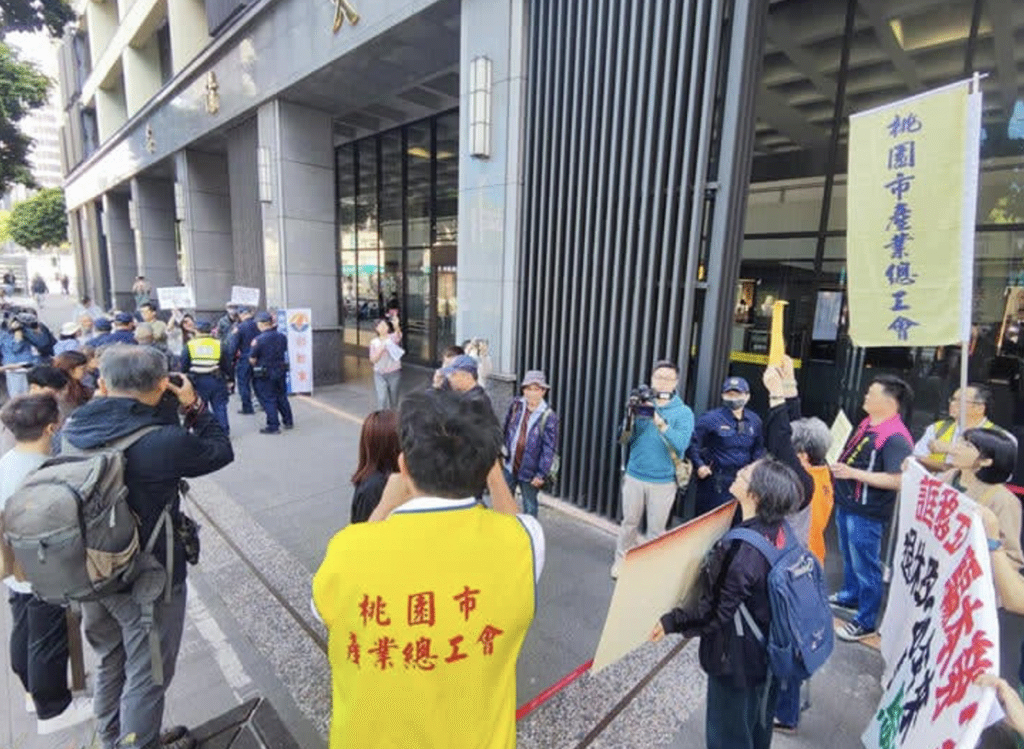
At its core, the growing hostility toward migrant workers, amplified by political parties and employer groups, stems from structural issues. Long-term elder care has become a major burden for families, and hiring migrant workers remains one of the few affordable and reliable options. In other words, many ordinary citizens are, or may become, employers of migrant workers. As migrant worker protections increase, so too do the costs for employers, which can significantly impact household finances. Without policies that both protect migrant workers and support employing families, this could lead to a zero-sum conflict among vulnerable groups.
At the same time, Taiwan’s rapid economic growth in AI and semiconductor industries has generated substantial wealth, but many workers (especially those in traditional industries or those excluded from capital markets) have not reaped those gains. As inequality worsens, dissatisfaction grows. In such a context, slogans like “Taiwan First” and narratives blaming foreigners or pro-migrant labor organizations are indicative of problematically misplaced frustrations at governmental failure.
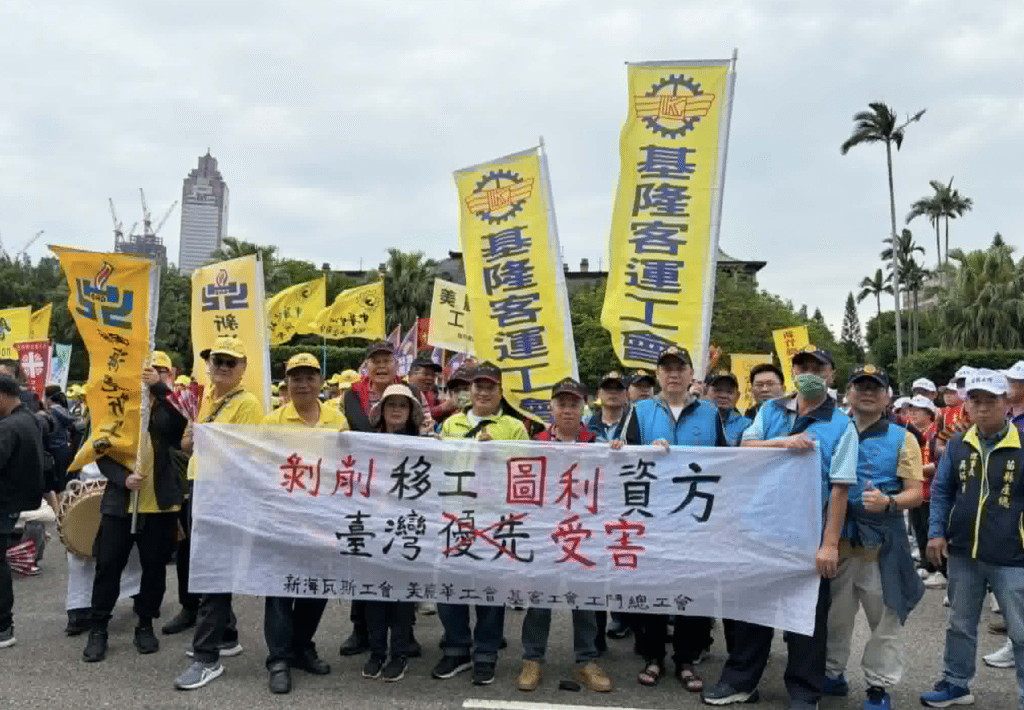
Although full-scale social division has not yet formed, tensions are steadily growing. If the topic of migrant worker rights continues to grow more entangled in ideological or partisan conflicts, this will not only hinder progress on these issues but also undermine solidarity between local and migrant workers, and potentially turn the labor movement into a casualty of political struggle. This is a development that those concerned with labor rights in Taiwan should closely watch.
[1] Workers march for a reform of pension system
[2] CBP issues Withhold Release Order on Giant Manufacturing Co. Ltd.
[3] Fact Sheet on U.S.-Taiwan Agreement on Reciprocal Trade