
Background on TaiDoc Technology Corp.
Founded in 1998 in Taiwan by Dr. C. W. Chen, TaiDoc Technology Corp. is a major manufacturer of glucose meters and blood pressure monitors, among other medical electronics, biochemistry, photometry, and software products. TaiDoc technologies are marketed to and used within hospitals globally, holding product certificates from EU, the United States, Brazil, Canada, Japan, to name a few. During the height of the COVID-19 pandemic, TaiDoc manufactured a comprehensive line of screening and monitoring tools. Crucially, TaiDoc’s production is sustained by over 100 migrant workers, who are primarily women from the Philippines employed at the company’s sprawling factory complex in New Taipei City.
Forced Labor and Gender Discrimination, Union Formation, and Government Intervention
Within the last half year, TaiDoc has come under scrutiny for not only coercing and abusing its migrant workers, but also engaging in active union busting. Management at TaiDoc Technology Corp. has worked alongside exploitative labor brokers (Kanglin Global Group, Jisheng Human Resources[1], and MITC) to coerce the company’s migrant workers. In addition to exploitative broker fees, workers reported different costs associated with continuing their employment with TaiDoc. Some paid up to NT$18,000 in rehire or renewal-related fees, while others were required to return to the Philippines and undergo recruitment and contract processing again before returning to TaiDoc, resulting in another placement fee despite having already worked for the company. Migrant workers at TaiDoc also faced widespread gender discrimination. A worker employed by BioCare, a TaiDoc subsidiary, was terminated following her pregnancy, and migrant women across the board were required to live in the company dormitory, while men were allowed to choose their own housing arrangements. Aside from being unfairly forced to live in the company dormitory, women migrant workers have to pay rent totaling NTD$3,500 per month, not including the extra NTD$500-600 per month for electricity.
Due to the incredibly punitive measures in place, some workers have previously described the dormitory as “prison-like.” The dormitory, located inside the factory, is marked by pervasive CCTV surveillance. Prior to and around the formation of the union, women living in the company dormitory were subjected to restrictive curfews, mandatory photo check-ins, restrictions on overnight stays, and punitive cleaning. Several of these practices were subsequently relaxed or discontinued following worker organizing, complaints, and increased scrutiny. However, workers say these changes have not been formalized in any written agreement or guarantee, leaving them concerned that the company could reimpose the previous restrictions. Spatially, the migrant workers’ dormitory at TaiDoc’s Wugu facility is located within one of the factory buildings, effectively placing workers’ living quarters within the broader factory compound. Due to the location of their rooms, several workers have reported that they often cannot sleep well due to the noise pollution of the machinery during night shifts. Furthermore, this placement of housing accommodation flies in the face of common-sense safety protocol. Typically, migrant living quarters ought to be spatially distanced from production areas containing hazardous or flammable materials. This is incredibly pertinent for Taiwan, as the nation has a history of several deadly factory fires which spread into adjacent migrant dormitories.
Migrants are actively discouraged from complaining, with the company management and labor brokers threatening dismissal, non-renewal of contracts, or repatriation. Management also weaponizes overtime shifts to pressure workers from joining the union. Due to incredibly low wages for migrant workers, many blue-collar migrants in Taiwan seek overtime hours to make more money. Thus, withholding overtime shifts can negatively impact the amount of money that migrants can save in order to send back home as remittances or pay back their broker debt.
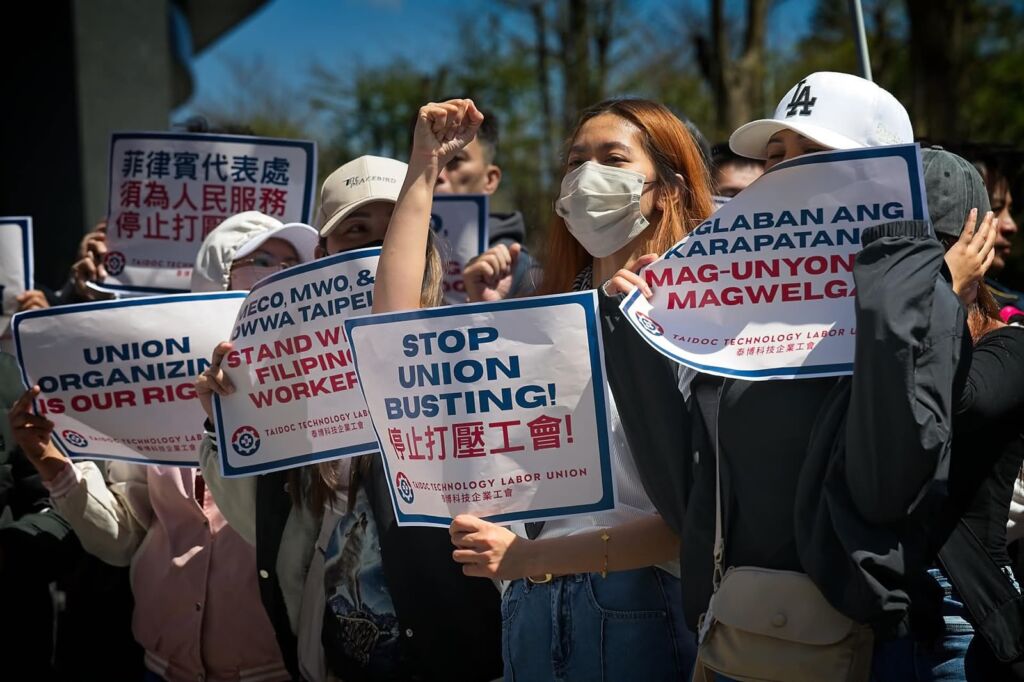
Beyond discouraging migrant workers from speaking up about conditions, TaiDoc management openly has retaliated against any collective action. On August 29, 2025, Filipina workers made history by formally establishing the TaiDoc Technology Labor Union (TTLU), the second migrant-led enterprise union in Taiwan. After enduring harsh working conditions created by their employer and labor brokers, over thirty migrant workers at TaiDoc Technology Corp. decided to take collective action.
TaiDoc Corp. has broken several Taiwanese laws in its egregious treatment of migrant workers. Some of this misconduct has been penalized by the government, while other violations remain unaddressed. For example, the discriminatory treatment and repatriation of pregnant women at TaiDoc is a direct violation of Taiwan’s Gender Equality in Employment Act. Recently, the New Taipei City Labor Bureau confirmed that TaiDoc’s management discriminated against pregnant migrant workers.
Retaliation against the TaiDoc Technology Labor Union and Government Response
In the nine months since its founding, the TTLU has faced aggressive retaliation from an entangled web of actors, including management at TaiDoc Technology Corp. and labor brokers. TaiDoc Technology Corp. has taken on several extreme efforts to retaliate against TTLU organizers, engage in union busting, and intimidate others from joining TTLU. Management at TaiDoc has dismissed seven union officers (six TTLU officers, including the union president, and one active union member who previously served as an officer) and recklessly sued TTLU for various criminal and civil charges. Currently, there are six, ongoing lawsuits (both civil and criminal) and two injunctions against the TTLU and its various organizers. The lawsuits range from defamation to embezzlement to forgery. Furthermore, TTLU has accused TaiDoc of attempting to interfere with and take control of the migrant-led union. Management-supported employees have claimed to have removed TTLU’s legitimate officers and held their own general assembly and elections, but these actions were not authorized by TTLU and the purported leadership change has not been accepted by the New Taipei City Labor Office. The existing TTLU officers therefore remain the union’s legitimate leadership. Separately, company-level unions have been established at TaiDoc’s Wugu and Nankan factories, which TTLU believes are management-led or company-dominated. After the initial public backlash to the company’s attempt to discharge TTLU’s president, workers reported increased CCTV surveillance in dormitory common areas and expressed concern that some of the newly installed cameras may also be capable of recording audio. On the company’s Mandarin-language site, management is offering a bounty for members of the public to target labor organizers by conducting “in-depth [analyses] on issues such as unionization, migrant worker policies and social structures, and uncovering the truth behind abnormal operations hidden behind official documents.” Note, this project is not made public on TaiDoc’s English-language site.
Meanwhile, brokers have threatened the workers, wielding the threat of contract non-renewal over workers’ heads. Blue-collar migrant workers in Taiwan are only eligible for three-year stints of work. Should their contracts not be renewed at the end of three years and should they not source another job (which often comes with an expensive transfer fee), they are typically repatriated back to their countries of origin. Some labor brokers have also threatened the secretary-general of the TTLU, making jokes about kidnapping and killing him in a massive group chat with over 500 brokers. Dangling the possibility of a Resident Visa for Intermediate Skilled Workers (which would allow workers to remain in Taiwan indefinitely), labor brokers and TaiDoc management have mobilized a group of “opposition” migrant workers who are on their third consecutive contract with the company and nearing their 12-year limit on residency in Taiwan. Certain brokers have also spread misinformation on their public social media accounts, attempting to stoke online hate against the organizing migrant workers in TTLU.
Following tireless advocacy from NGOs in Taiwan and public pressure, authorities in Taiwan have also stepped in with regards to TaiDoc’s retaliation against worker organizing. Article 8 of Taiwan’s Labor Dispute Resolution Act also stipulates that during the mediation, arbitration or adjudication of a labor dispute, employers may not suspend business, stop work, terminate labor contracts or take other actions that are detrimental to workers because of the labor dispute. The determined violation of this provision can result in a fine between NTD$200,000 and NTD$600,000. The New Taipei City Labor Bureau also confirmed that during the ongoing labor disputes, TaiDoc management demanded that the union president withdraw from the union and hand over the membership list, in addition to denying the president overtime, which violated the provisions of the Labor Dispute Resolution Act. Thus, TaiDoc Company was fined NTD$200,000. Overall, TaiDoc has been fined NTD$1.05 million thus far. The seven dismissed workers were subsequently reinstated following legal action challenging their dismissals. However, given the company’s longstanding attempts at pitting workers against each other, these union members are now enduring ostracization from colleagues and management.
External backlash against workers
In addition to TaiDoc management and labor brokers, public officials and Taiwan’s far-right political party have also joined in on the backlash against these workers. Prior to the formation of TTLU, TaiDoc workers turned to a case officer at the Manila Economic and Cultural Office (MECO), only to be told that their mistreatment was simply “company policy.” This same case worker has also participated in some of the discussions between TaiDoc management and opposition members, resulting in MECO’s publication of an ambiguous statement in which it attempted to remain neutral. However, any clear-sighted analysis of the outstanding power imbalance between the management and migrant workers reveals that so-called “neutrality” only serves the entity with more relative power. In addition, the Department of Migrant Workers, which seeks to uphold the welfare of Filipino overseas workers, published a misleading memo overtly undermining TTLU’s statements.
The Taiwan Solidarity Party (TSP), a far-right political party, has also entered the fray, weaponizing growing xenophobic sentiments in the nation to foster public antagonism towards these workers. A day after International Workers’ Day, the TSP and the Taiwan Employers’ Association invited TaiDoc management to join the Employers’ Day Rally on May 2nd in Taipei. It was at this event where the CEO of TaiDoc declared that the TTLU union members and their allies were “cockroaches.”
Failures of the system to protect workers
Despite limited attempts at holding TaiDoc accountable, Taiwan and the global market continue to fail the company’s precarious migrant workers. For example, following increased pressure from its clients, TaiDoc hired a German monitoring organization, TÜV SÜD, to conduct audits of the company. However, research has consistently shown the limitations of auditing companies when it comes to upholding corporate accountability (Defond and Zhang, 2025[2]; Leaver et al., 2020[4]). As assurance companies are hired (and thus fired) by the corporations under investigation, it is not uncommon for audits to “ethics-wash” their clients. In TÜV SÜD’s audit of TaiDoc, only the production floor was examined, without any scrutiny of the living conditions endured by workers within the very same buildings. Furthermore, no migrant workers were interviewed, which is a shocking methodological failure. Another UK-based assurance company, Intertek, had initially offered to audit TaiDoc, but as of yet, has not responded to TTLU’s supply of copious documentation and evidence.
Simultaneously, the news media has also failed to amplify the voices of TaiDoc’s migrant workers. On the global stage, the plight of these workers has received little to no coverage in newspapers outside Taiwan. Within Taiwanese media, there has been more coverage of the case. However, some of the major media firms have painted biased portrayals of the case, often positioning the migrant workers and the corporation on equal footing, or even going so far as to amplify allegations that migrant unions are exploiting employers and the legal system (FTV, 2026[5]).
There are still violations of certain laws for which TaiDoc has not yet been held accountable. According to Article 35 (Paragraph 1) of the Labor Union Act (工會法), employers in Taiwan are prohibited from retaliating against union activity with dismissal, demotions, wage cuts, and refusal of employment. Within Taiwanese law, the dismissal of union officials during a trial for unfair labor practices can result in a fine ranging from NTD$100,000 to NTD$500,000. Furthermore, Article 35 (Paragraph 1) also states that employers are also not permitted to obstruct or interfere with the formation of labor unions.
Furthermore, Taiwan currently lacks any robust regulation against forced labor. However, on a global stage, many jurisdictions have legislations prohibiting the import of products made with forced labor. The next section will cover stances on forced labor delineated by several key international organizations and regulatory bodies in the West, to which TaiDoc exports many of its products.
International violations of forced labor regulations
The International Labour Organization (ILO) Forced Labour Convention, 1930 (No. 29) defines forced or compulsory labor as any “work or service which is exacted from any person under the threat of a penalty and for which the person has not offered himself or herself voluntarily.” Meanwhile, the European Commission elaborates on the ILO definition, noting that “situations in which persons are coerced to work through violence, intimidation, manipulated debt, retention of identity papers, or threats of denunciation to immigration authorities” constitute forced labor. Under this critical piece of legislation, the EU Commission aims to ban all products made with forced labor from being sold in the EU market, entering into force in 2024 and taking full effect in 2027. The U.S. Customs and Border Protection, which recently blocked imports from a Taiwanese bike company due to forced labor practices, upholds Section 307 of the Tariff Act of 1930 (19 U.S.C § 1307). This section crucially stipulates that any products produced “wholly or in part in any foreign country by convict labor and/or forced labor and/or indentured labor under penal sanctions shall not be entitled to entry into the U.S.” While the United Kingdom lags behind the EU and the US on a substantive ban on the import of products made with forced labor, there are currently discussions underway to mobilize a more comprehensive and legally-instated prohibition, as evidenced by the recent Joint Committee report: Forced Labour in the UK’s Supply Chains (2025).
As TaiDoc products are marketed to and used within hospitals in the EU, US, and UK, there needs to be international pressure placed on the corporation in accordance with provisions against forced labor. Western hospitals, healthcare workers’ unions (e.g. Union of American Physicians and Dentists, Confédération des Syndicats Médicaux Français, etc.) and medical associations (e.g. American Medical Association, German Medical Association, etc.) need to investigate the supply chains of the devices they use and speak up on behalf of the TaiDoc workers. For an industry that claims patient and societal well-being as a core ethical tenet, paying heed to forced labor and union suppression elsewhere in the world is crucial.
[1] Migrant workers under Jisheng Human Resources were required to pay NTD$3,600 for private insurance, which is effectively a way to protect the employer should any work-related accident happen.
[2] Audit failures: why they occur and some suggestions for reducing them (Defond and Zhang, 2025)
[3] Auditing with Accountability: Shrinking the Opportunity Spaces for Audit Failure (Leaver et al., 2020)
[4] 移工工會變「開罰產業鏈」? 律師怒控不肖業者靠勞資衝突牟利 (FTV, 2025)
Contribution from Katherine M. Zhou.