
Workers Behind the AI Boom
Recently, high-bandwidth memory (HBM) has become the tightest bottleneck in the entire AI industry, and it is dominated by three firms: Micron, SK Hynix, and Samsung. These three corporations effectively supply all of the world’s DRAM (dynamic random-access memory) and HBM chips. As the rapid proliferation of AI models and data centers heightens demand for memory chips, Micron says its entire 2026 HBM output is already sold out. To expand its capacity for production, Micron has announced ambitious expansion plans totaling well over a hundred billion dollars. This current rush marks a structural, multi-year boom for memory producers.
However, the fabs do not run themselves. Behind emphasized depictions of “smart,” automated fabs, chips are produced by tens of thousands of engineers, technicians, and operators—a workforce concentrated heavily in Taiwan. Of the historic windfall generated by the AI boom, how much will reach the countless workers who produce the chips? Ultimately, who makes this decision?
Micron Taiwan
Micron’s astronomical growth masks the growing indignation that has rippled through its workforce in Taiwan. This section provides some context about Micron’s operations in Taiwan, as detailed extensively in a previous Taiwan Labor Watch article: Dismissal, Litigation, and Clawback of Wages: Micron in Taiwan.
Entering Taiwan via Acquisitions
Micron, an American company, acquired its Taiwan facilities during a series of financial crises when chip rivals were collapsing. During the 2008 financial crisis, Micron picked up Qimonda’s stake in Inotera (the DRAM joint venture with Nanya Technology based in Taoyuan City). In doing so, Micron was able to take operational control of Inotera’s capacity. By the end of 2016, Micron had bought out Nanya’s remaining Inotera shares, thus acquiring the entire operation, which was renamed to Micron Technology Taiwan. In 2013 Micron acquired the bankrupt Japanese firm Elpida, which came with its Taiwanese subsidiary (Rexchip) in Taichung City. This massive acquisition was renamed Micron Memory Taiwan.
With this series of moves, an American chip company came to own a massive chip operation in Taiwan. Today its fabs in Taiwan account for well over half of Micron’s global DRAM capacity, and the company is the single largest foreign-invested enterprise in Taiwan. Its position in the AI memory market rests, physically, on Taiwanese production.
Documented Labor Abuse
Micron’s full ownership in 2016 was immediately followed by restructuring and mass layoffs that ultimately impacted roughly one third of Inotera’s some-3,000 workers. When the remaining employees formed a union and entered collective bargaining, the company actively engaged in harsh union busting. Two hours before the sixth bargaining session in November 2017, Micron fired the union chair, Feng Ze-Yuan, then used a subsequent incident to justify a “second dismissal” and to file criminal charges against him. Taiwan’s official labor board later ruled that Micron’s actions constituted unfair labor practices, and declared Feng’s dismissal invalid. Micron nonetheless kept the dismissal in place, and after years of litigation, the company went so far as to sue Feng to “claw back” the wages he had been paid under a court injunction during the case. This atrocious conduct was publicly condemned by the Ministry of Labor as an abuse of litigation. Eventually, the courts finally rejected Micron’s wage clawback attempts. The pattern from 2017 to 2024 is consistent: aggressive use of dismissal, courts, and money to wear down organized workers.
American Interference Against Workers in Taiwan
Rather than accept the courts’ protection of workers, the American Chamber of Commerce (AmCham) in Taiwan flexed its soft power by demanding in its 2025 policy white paper that the Taiwanese government amend the very law (Article 49 of the Labor Incident Act) that had protected Feng. In doing so, AmCham problematically underscored its alignment with employers, effectively asserting that firms should be able to ban reinstated workers as well as claw back employer wages. This was an attempt to weaken, at the legislative level, the legal shield upon which vulnerable workers depend. In October 2025, unions in the greater Taoyuan area joined together with unions from other American-invested companies to protest at the AmCham office. Resoundingly, they demanded that U.S. firms respect Taiwanese labor laws.
Micron’s Unfair Employee Bonus System
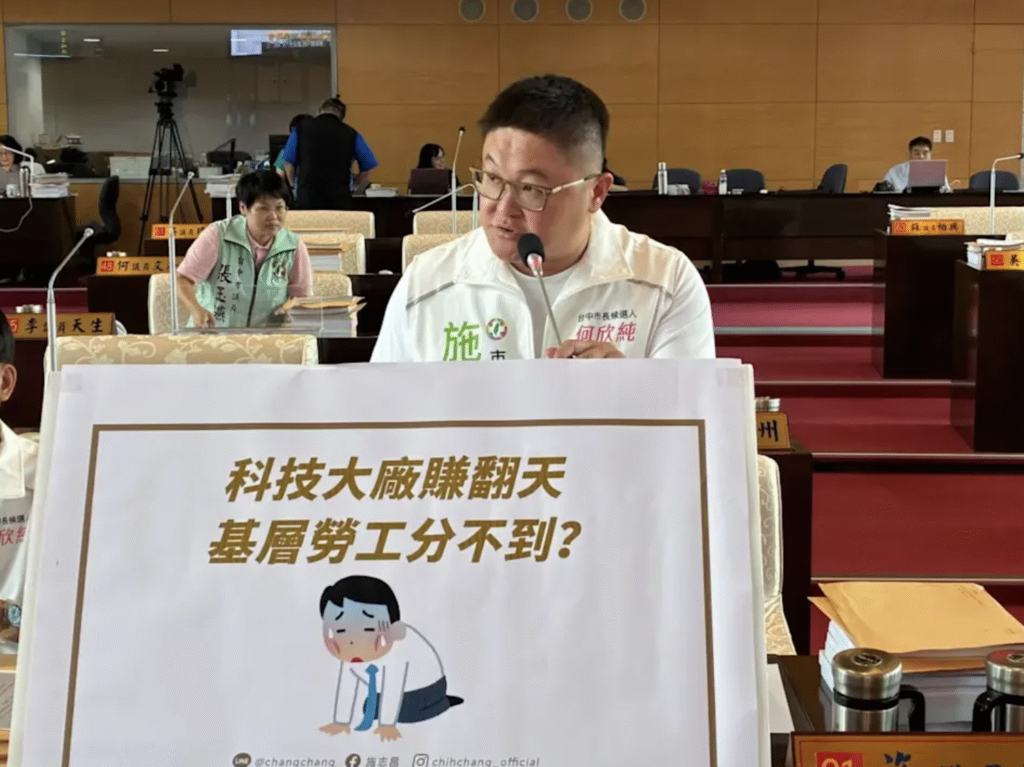
Rumblings of a potential strike amongst Micron workers have emerged, with employees protesting the company’s unfair and opaque compensation scheme. Micron distributes profit-related bonuses to its workers in Taiwan through a formula called the incentive pay plan (IPP):
* Annual salary = monthly salary × 14
Bonuses hinge on one variable: the company performance achievement rate. This rate has a crucial effect on the total bonus received by an individual worker. Three major problems emerge from this IPP system.
Issue One: Micron’s “Company Performance Achievement Rate” is a Black Box
How the achievement rate is calculated is not disclosed. Management at Micron sets it unilaterally and internally. Workers cannot contest the single number that decides their bonus. They just have to accept it.
A statistical analysis based on years of public data indicates that the company performance achievement rate is closely related to the year-over-year (YoY) revenue growth rate. The revenue growth rate is roughly 90% + YoY%. In this case, if an average worker’s individual performance is set to 1, Micron’s IPP is reduced to:
In other words, once decoded, IPP seems to be driven overwhelmingly by the revenue growth rate, not by how much money the company actually makes. This segues into the next two problems.
Issue Two: Bonuses are Decoupled from Micron’s Profit
Because the IPP is tied to the YoY revenue growth rate, it can collapse even when the company is wildly profitable. No matter how large the company’s profits are in a given year, if revenue is barely higher (or worse, even lower) relative to what it was in the prior year, YoY is low (or negative) and the bonus shrinks accordingly. Crucially, this decrease in bonus can occur even as the company books record earnings. The bonus rises only while the company is expanding rapidly. The moment Micron’s growth slows, workers are severed from the profits they are still producing.
Issue Three: Bonus Ceiling at 200%
Even when there is rapid growth, Micron’s management caps the company performance achievement rate at 200%. Take the campaign’s projection for the 2026 financial year. With estimated full-year revenue around US$129 billion in 2026 and revenue up roughly 245% YoY, the decoded formula gives a theoretical company achievement rate of about 335%. A rate of 335% would then translate into a bonus of about 8.4 months of a worker’s salary. But the cap freezes the achievement rate at 200%, which yields:
So by Micron’s IPP formula without the cap, workers are owed roughly 8.4 months of base salary in the IPP for the year of 2026. The cap limits their bonus to roughly 5 months of base salary. More than three months of earned bonus simply disappears. No matter how much the company makes, or how far it outgrows the prior year, Micron’s employee bonuses will always have a ceiling of five months of base salary.
Towards a Strike
Strike Preparation and Union Demands
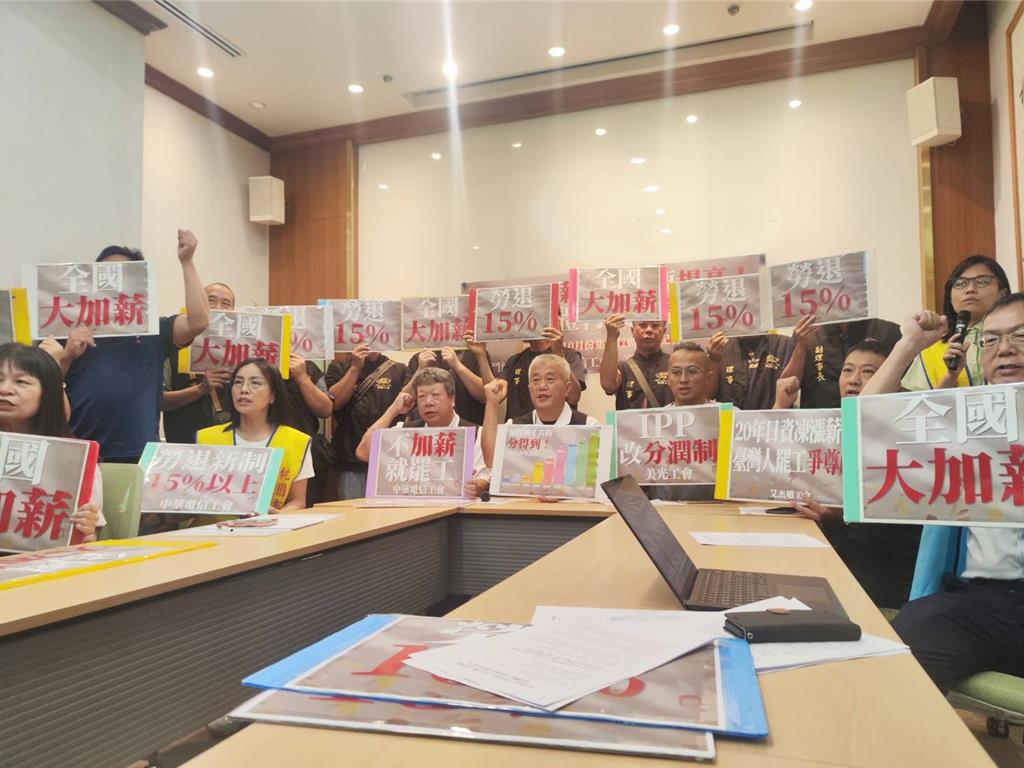
Because Micron’s current IPP system fails to provide a fair and transparent mechanism for sharing the company’s profits with employees, the Micron Technology Taiwan Union (based in Taoyuan) and the Micron Memory Taiwan Union (based in Taichung) have both announced that they are entering the strike preparation stage. These two unions are calling for the following:
The primary focus is on reforming the bonus distribution system and switching from a relative-value bonus (growth-dependent, capped, and opaque) to an absolute-value profit-sharing scheme that is tied to the company’s actual profit. The unions propose:
Bonus per worker = (company operating profit × 15%) ÷ headcount*
*Micron’s headcount is currently around 56,000.
Many of Micron’s peer companies (including TSMC, Nanya Technology, SK Hynix, and Samsung) adopt profit-sharing schemes with sharing ratios ranging between 2% of pre-tax profit and 15% of after-tax profit. By comparison, Micron provides its employees in Taiwan with an IPP bonus capped at five months of salary, which amounts to less than 1% of its operating profit in 2026.
Mediation
Under Article 35 of Taiwan’s Act for Settlement of Labor-Management Disputes, “industrial dispute actions cannot be undertaken unless mediation of the labor-management dispute has not been successfully concluded.” Accordingly, the Micron union in Taoyuan held its first mediation session with Micron’s management on September 4, 2026. During that meeting, Micron’s management made several statements:
The Taichung union will hold its first mediation session with management on September 18, 2026.
A Contradictory Proposal from Micron’s Management
Despite the above statements issued by management to the Taoyuan union, Micron went back on its word in public. On September 10, 2026, Micron unilaterally announced a proposal to the public which stipulated a one-time bonus of US$32,000 per employee, an IPP payout of 300%–500% of the IPP target, stock awards of up to US$10,000, and annual Merit Stock Awards. According to an official of the Micron union in Taichung, the Annual Merit Stock Awards are valued at US$6,000 per employee. The proposal also includes increases in the base salary and stock compensation budget.
Although the company appears to have proposed a form of profit sharing, the unions and TPEC estimate that all of these payments combined would amount to only approximately 4–5% of the company’s 2026 operating profit. This falls far short of the 15% of operating profit demanded by the unions, and is less than half the profit-sharing ratio provided by industry peers such as Samsung and SK Hynix.
Most importantly, the proposal contains no commitment whatsoever from management to convert the IPP system into a profit-sharing scheme, despite this being one of the unions’ key demands and a matter that management had previously agreed to negotiate.
In response, both the Taoyuan and Taichung unions issued statements rejecting the unilateral proposal as unacceptable and announced that they would continue preparations for a strike.