
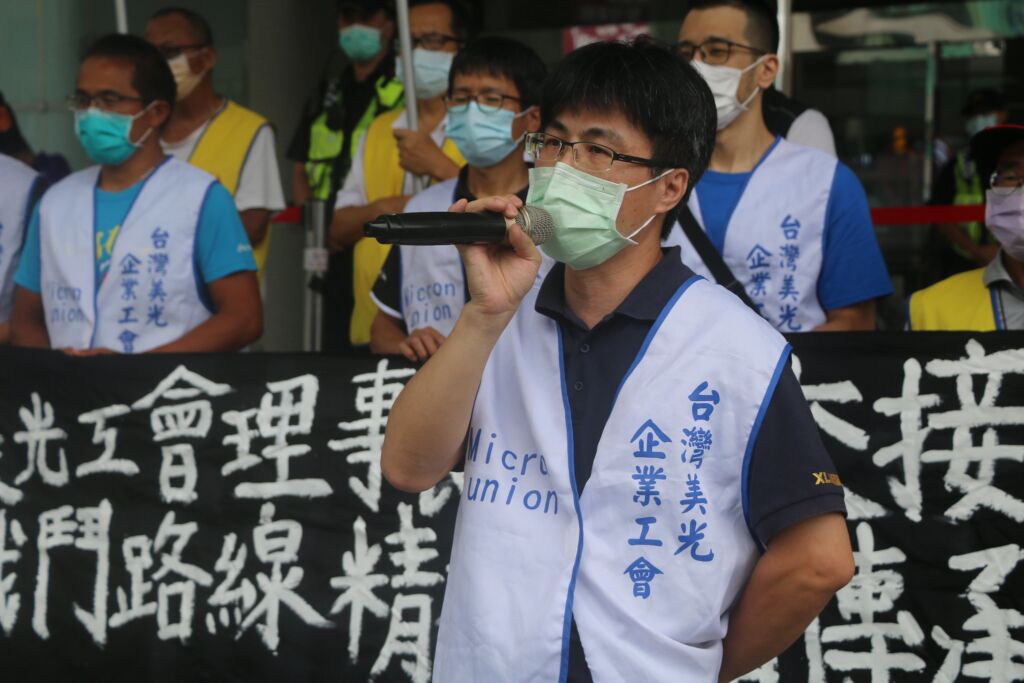
Micron’s Rise in Taiwan
Prior to 2008, the global DRAM industry was a fierce battlefield. DRAM (dynamic random access memory) is a form of semiconductor memory used in devices for high-speed data storage. Thought South Korea’s Samsung and Hynix were the frontrunners in global market share, intense competition still existed between America’s Micron, Germany’s Qimonda, and Japan’s Elpida. However, the financial crisis allowed Micron to leapfrog into a steady position amid the top three globally, and the key to the company’s transformation lay in Taiwan.
During the 2008 financial crisis, the DRAM market collapsed, and Qimonda fell into financial ruin. It was no longer able to inject capital into Inotera, a DRAM foundry co-founded with Nanya Technology of the Formosa Plastics Group. Inotera, which was producing 120,000 wafers every month and running two 300mm wafer fabrication facilities at the time, was in dire need of support. Consequently, Nanya Technology turned to Micron for technology and funding. That same year, Micron acquired Qimonda’s shares in Inotera, directly gaining half of Inotera’s total manufacturing capacity. At the time, Inotera already operated two 12-inch wafer fabs. For Micron, this monumental saved the company time, cost, and risks associated with building new plants. Not only acquisition did it cause Micron’s global market share to surge but it also secured technical royalty fees from Nanya Technology and gained the Formosa Plastics Group as an ally to share risks.
In 2013, as DRAM market remained highly competitive, Nanya Technology and Micron renegotiated their contract. While their previous model stipulated that each company split Inotera’s production capacity, the amended relationship introduced an “option to acquire” model. Nanya’s intention was to pivot toward smaller niche markets to avoid competition in the DRAM market, all while reducing royalties paid to Micron. Although Inotera was still obligated to supply Nanya Technology, this move essentially gave Micron control over Inotera’s entire production capacity. That same year, Japan’s Elpida, another competitor, went bankrupt. Micron directly acquired Elpida, taking over not only its Japanese capacity but also its Taiwanese subsidiary, Rexchip (Rijing), subsequently renamed Micron Memory Taiwan. Notably, Rexchip’s production capacity was several times higher than that of the Japanese plants.
At the end of 2016, Micron acquired all of Nanya Technology’s shares in Inotera, officially owning all of its production capacity and renaming it Micron Technology Taiwan. With this, Micron completed its DRAM empire and secured its place in the global top three. Today, its Taiwan production alone accounts for over 60% of its total DRAM capacity, while US production accounts for only about 10% and Japan for 20%. Simultaneously, Micron has become the largest foreign-invested enterprise in Taiwan.
Dismissal, Abuse of Litigation, and Unfair Labor Practices
After Micron officially gained full control of Inotera, intense labor disputes followed. Although Micron had held equity in Inotera since 2008, it had only co-managed the company with Nanya Technology up its until full acquisition at the end of 2016. Following the full acquisition, the management intended to implement a comprehensive restructuring of Inotera’s internal management system. Micron replaced Inotera’s management tier and laid off almost 1,000 employees out of Inotera’s original workforce of nearly 3,000. Afterwards, remaining employees established a union at the end of 2016 and engaged in nearly a year of collective bargaining with Micron. The focus of the negotiations was on ensuring job security, maintaining original labor conditions, and preventing the employer from unilaterally changing the management system. During this period, the chairperson of this new company union, Feng Ze-yuan, assisted numerous employees. Coupled with the union’s firm stance during negotiations, Micron subsequently launched aggressive union-busting actions.
On November 14, 2017, just two hours before the sixth collective bargaining session with the union, Micron abruptly announced the dismissal of Feng Ze-yuan. The company justified its decision, pointing to his previous violation of access control regulations in October, specifically for bringing an organizer from a higher-level labor organization into the union office located within the factory. That afternoon, Feng attempted to enter the negotiation venue to protest. During the heated and stressful ordeal, he threw a plastic water bottle in a state of agitation. This action then became the employer’s justification for a ‘second dismissal,’ and the company subsequently filed criminal charges against Feng for injury and defamation. Simultaneously with Feng’s dismissal, the employer also prompted the union’s vice chairperson to take a voluntary early retirement package and exerted pressure on other union officers. This clearly indicates that these actions were not directed at an individual, but were aimed at the entire union.
The Board for Decision on the Unfair Labor Practices under the Ministry of Labor ruled that while the union office was situated on the employer’s property, it served as an essential space for union operations, and Micron could not use access as a pretext to completely block the union’s communication with the outside world [1] . Simultaneously, the committee pointed out that Micron’s dismissal of Feng was excessive punishment [2] . Since the dismissal occurred right before collective bargaining, it was viewed as a targeted attempt to obstruct union activities. Thus, the committee ruled that Micron violated Article 35, Paragraph 1, Subparagraphs 1 (“Unfavorable Treatment”) [3] and 5 (“Dominance and Interference”) [4] of the Labor Union Act . The dismissal was declared void, and Micron was ordered to reinstate Feng and pay his salary. Furthermore, the committee ruled that the litigation Micron initiated against Feng was an attempt to use legal procedures to pressure union members, which also constituted an unfair attempt attempt labor practice of “Dominance and Interference”.
Clawback of Wages
Despite this, the management maintained the dismissal, citing the bottle-throwing incident. Feng subsequently filed a civil lawsuit to “confirm the existence of an employment relationship,” starting a lengthy and arduous process. In 2020, the Labor Incident Act came into effect [5] . Feng cited Article 49, Paragraph 1 to apply for a “Status Quo Injunction” (interim measure) [6] . The original intent of this law was to prevent workers from falling into financial hardship during long legal battles. The court immediately ruled that Micron must continue to employ Feng and pay his wages until the final judgment. While Micron complied with the wage payments, they cited “employee protection” as a reason to refuse Feng entry into the factory for work.
In June 2022, nearly five years later, the Supreme Court finally ruled that Micron’s dismissal based on access control violations was invalid. However, although Feng Ze-yuan’s subsequent protests could not be viewed in isolation from the employer’s unfair labor practices, and despite the fact that the evidence was entirely based on one-sided testimony from the employer, the court still ruled that his actions constituted gross insult or violence against the employer’s agent. This was deemed a legal ground for dismissal under Article 12 of the Labor Standards Act . Following the final judicial ruling, the union suffered a major blow.
However, Micron did not stop there. Citing Article 49, Paragraph 4 of the Labor Incident Act [7] , the company claimed that since Feng was paid after 2020 but provided no labor, the wages he received during the litigation constituted “unjust enrichment”. Micron sued Feng to return approximately NT$2 million in wages. The overarching union, Taoyuan Confederation of Trade Unions, immediately held a press conference condemning Micron for manipulating the law and persecuting workers. In January 2024, the Ministry of Labor took the rare step of publicly criticizing Micron for refusing Feng entry into the factory at the time and then attempting to claw back his wages, calling the behavior “unreasonable and an abuse of litigation” that violated the protective intent of the Labor Incident Act. Ultimately, after the Taiwan courts twice rejected their claims, Micron finally terminated the lawsuit for the return of the wages.
Although Micron’s claim for damages failed, the American Chamber of Commerce (AmCham) Taiwan published its 2025 white paper on Taiwan policy, directly demanding that the Taiwanese government amend Article 49 of the Labor Incident Act . They requested that employers have the right to refuse employees entry to the workplace during ‘preliminary injunctions’ (status quo injunctions) and claw back wages if they eventually lose their lawsuits. This move directly aimed at weakening the protections provided by Taiwanese laws for vulnerable employees. In a rare move on October 9, 2025, the Taoyuan Federation of Labor Unions, along with several unions from American-invested companies, protested at AmCham Taiwan, demanding that American companies respect labor rights and comply with Taiwanese laws.
From union-busting in 2017, to the wage clawbacks in 2024, to AmCham’s 2025 white paper, it is evident that not only has Micron has consistently demonstrated its aggressive approach in Taiwan, but also the legal protections for workers and unions in Taiwan remain fragile. Employers can exploit various legal loopholes to suppress unions and dismiss dissenters, even using their formidable political influence to pressure Taiwan’s rule of law. In such a climate, Unions are either driven to maintain a low profile or forced into silence, and labor rights are largely eroded the power of capital. In this case study, it is clear that Micron’s DRAM empire is built upon the backs of Taiwanese workers.
“In Taiwan, the Micron I faced possesses the power to make the government subservient, clearing the path for any of its actions. This goes beyond mere capital; even when laws are violated, judicial branches still pave the way for them. Only by uniting all allies can we counter such power and fight for our rights. Comrades, let us fight on together!” – Feng Ze-Yuan, 2026
[1] Case Translation: Ministry of Labor Unfair Labor Practice Decision No. 63 (2017)
[2] Case Translation: Ministry of Labor Unfair Labor Practice Decision No. 70 (2017)
[3] Subparagraph 1 (“Unfavorable Treatment”) refers to a company’s dismissal, demotion, or unfair treatment of, refusal to hire, or reduction of wages for an employee who organizes or joins a labor union, participates in activities held by a labor union, or assumes the office of a labor union
[4] Improperly influence, impede or restrict the establishment, organization or activities of a labor union
[5] The Labor Incident Act was established to specialize in the handling of ‘rights-based’ labor disputes and to accelerate proceedings through a mandatory mediation mechanism presided over by judges. Simultaneously, the Act increases the burden of proof for employers and allows employees to apply for an ‘injunction maintaining the temporary status quo’ before a final judgment is rendered. Once such an injunction takes effect, the employer is required to maintain employment and continue salary payments.
[6] If the court recognizes that the case for confirming the existence of an employment relationship, as initiated by the worker, has a chance to prevail, and that the employer has no major difficulties in continuously employing the worker, the court may order a temporary status quo injunction, based on the worker’s motion, for continuous employment and payment of wages.
[7] If the court revokes a ruling, as mentioned in paragraph 1 and paragraph 2, due to the worker receiving a binding and losing judgment, the court may, on the employer’s motion, order the worker to return the paid wageswithin the scope of revocation, and the added interest since the date of receiving the wages. However, this provision does not apply, if the worker has provided labor services pursuant to the ruling, as described in paragraph 1 and paragraph 2.